
 ?
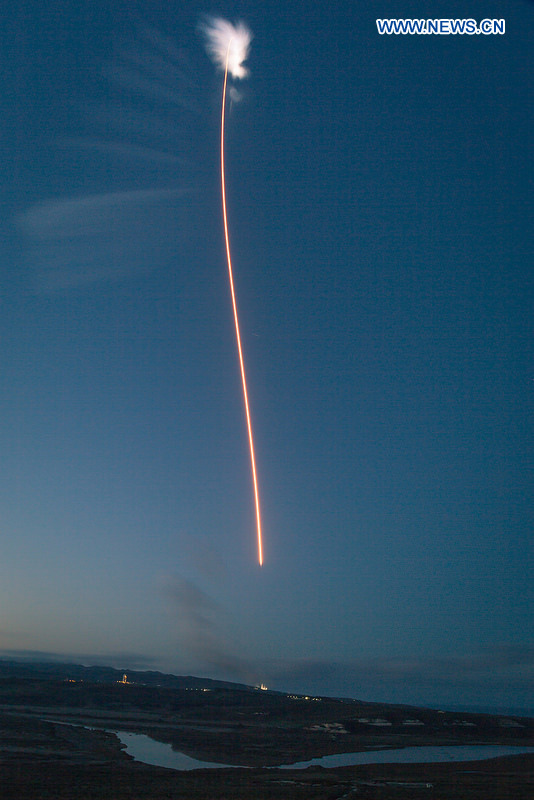
?A Falcon 9 rocket is launched with Spain's PAZ, a radar-imaging satellite, and two SpaceX test satellites for global broadband at Vandenberg Air Force Base in California, the United States, Feb. 22, 2018. (Xinhua/SpaceX)
LOS ANGELES, Feb. 22 (Xinhua) -- SpaceX completed another launch of its Falcon 9 rocket early Thursday with first two prototype satellites of its global broadband internet-in-space project, Starlink, successfully deployed in orbit.
"First two Starlink demo satellites, called Tintin A & B, deployed and communicating to Earth stations," SpaceX CEO Elon Musk tweeted.
A used Falcon 9 rocket blasted off at 6:17 a.m. local time (1417 GMT) on Thursday from Space Launch Complex 4E at California's Vandenberg Air Force Base.
The Falcon 9's first stage separates from the second stage moments after about two minutes from liftoff.
The launch's primary mission is to deliver PAZ, a radar-imaging satellite, into orbit for the Spain-based company Hisdesat.
"Successful deployment of PAZ satellite to low-Earth orbit confirmed," the California-based company confirmed.
According to the mission description, equipped with an advanced radar instrument, PAZ will cover the entire globe in 24 hours, serving both commercial and government needs. Designed for a mission life of five and a half years, PAZ will orbit Earth 15 times per day, covering an area of over 300,000 square kilometers from an altitude of 514 kilometers and a velocity of seven kilometers per second.
However, Paz was not riding alone on the recycled Falcon 9. Quietly on board were SpaceX's two experimental broadband satellites, Microsat-2a and Microsat-2b, a big first step in SpaceX's long-term plan to create satellite internet over the next decade.
The company has been relatively mum about the debut of its Starlink satellites, and about the entire program itself.
"The Falcon launch carries 2 SpaceX test satellites for global broadband. If successful, Starlink constellation will serve least served," Musk teased on Wednesday.
According to the open files between SpaceX and the U.S. Federal Communications Commission (FCC), in the coming years, the private U.S. space firm hopes to create a giant constellation of about 12,000 of interlinked broadband-internet satellites that will orbit in a synchronized dance above Earth, delivering broadband access anywhere in the world.
Some 4,425 satellites will sit at low earth orbit (LEO), an estimate of 1150 to 1325 kilometers above Earth, while another 7,518 satellites will be launched into very-low-earth orbits (VLEO), some 335 to 346 kilometers above Earth.
According to a tally by the Union of Concerned Scientists, there are 1,738 satellites currently orbiting Earth.
Earlier this month, FCC Chairman Ajit Pai gave his endorsement to SpaceX's application to operate two huge constellations of broadband satellites.
Falcon 9's first stage for the mission previously supported the FORMOSAT-5 mission from SLC-4E in August 2017. SpaceX didn't attempt to recover Falcon 9's first stage after Thursday's launch, because it "was an older version booster."
However, there is another heightened interest in this launch.
By using "Mr. Steven," a large navigable platform ship with extended "arms" and a net strung between them, SpaceX was trying to "catch" at least one of the two payload fairings that enclose the satellite at the top of the rocket.
These fairings were separated from the rocket at about three minutes after launch.
The value of these fairings is about six million U.S. dollars, and recovering and reusing them would save money for SpaceX. Currently, a typical Falcon 9 launch costs around 62 million U.S. dollars.