




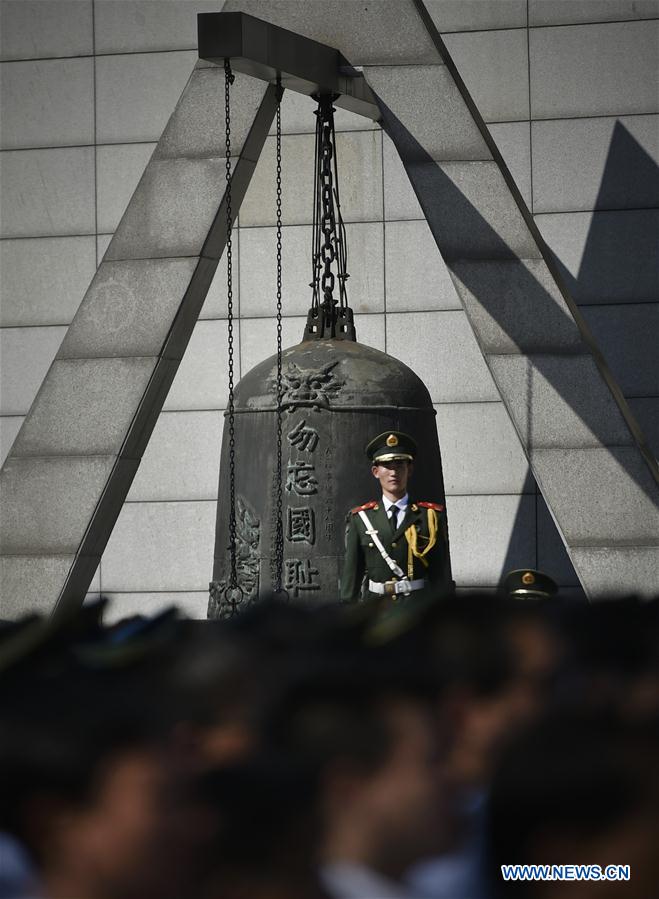
A bell-striking ceremony to mark the 87th anniversary of the "Sept. 18 Incident" is held at the 9.18 Historical Museum in Shenyang, northeast China's Liaoning Province, Sept. 18, 2018. (Xinhua/Yao Jianfeng)
SHENYANG, Sept. 18 (Xinhua) -- On Tuesday morning, air raid sirens sounded for three minutes in Shenyang and 13 other cities in northeast China's Liaoning Province to mark the 87th anniversary of the "Sept. 18 Incident", the start of Japan's invasion of China.
On hearing the sirens, Ji Ning, a 42-year-old guide at the 9.18 Historical Museum in Shenyang, the provincial capital, knew that a large crowd of visitors would soon arrive at the museum and she would explain to them one of the darkest pages of China's history.
COMMEMORATION
The sirens on Sept. 18 each year serve as a reminder of Japan's aggression. The Sept. 18 Incident occurred in 1931 when Japanese troops blew up a section of railway under their control near Shenyang and accused Chinese soldiers of sabotage as a pretext for the attack. They bombarded Chinese barracks near Shenyang the same evening, beginning a large-scale invasion of northeast China.
"In the early years, many people even did not know why there were wailing air raid sirens. But they gradually came to learn the significance," said Ji.
Many countries, including China, keep the tradition of commemorating those lost during war even though war is just now a part of history, she said.
Ji leads four to five groups of people to visit 510-meter-long exhibitions, including over 800 photos, 300 physical objects, and several simulated war scenes, on almost every working day over the past 20 years.
"There is one Sept. 18 each year, but our routine work is all about 'Sept. 18'," she said.
HEROES
At the start of each tour, Ji begins with the "Sept. 18 Incident". "I prefer talking more about the Chinese army' and civilians' fight against Japanese invaders. It's inspiring to recount stories of the wartime heroes," she said.
As a mother, Ji feels hurt whenever she recounts the story of Zhao Yiman, a legendary heroine who fought in China's northeast and was captured and killed by Japanese occupation forces at the age of 31.
Zhao left her final words to her son in a letter, saying she regretted not fulfilling her duty of raising her son and hoped he would remember that his mother died for the motherland.
"What made a mother abandon her son?" said Ji, adding that if people understand Zhao, they would have a good understanding of the Chinese People's War of Resistance Against Japanese Aggression.
Besides Zhao, there are many more nameless wartime heroes.
Since the "Sept. 18 Incident", China waged a war against Japanese aggression for 14 years and finally won the first full victory against foreign invasion since the Opium War in 1840 at the cost of over 35 million military and civilian casualties.
Ji recalled that one woman in her 70s from another northeastern province of Heilongjiang once visited the museum, carrying an old letter from her father saying he would join the anti-Japanese volunteer army in Liaoning. She had been searching for her father for many years, but all her efforts were in vain.
Ji led her to the national anthem wall and told her the original song of the national anthem "March of the Volunteers" was written for the volunteer soldiers like her father.
"After hearing my words, she burst into tears and then bowed three times in front of the wall," Ji said.
"We should not forget history. Otherwise, we feel sorry for the heroes," said Ji. She said she was glad that many visitors left words like "do not forget national humiliation" and "revitalize the Chinese nation" on the quest book.
PEACE
The museum, which hosts 1 million visitors annually, has become a major place for China to host the activities in commemoration of the war against Japanese aggression. Air raid sirens have sounded in Shenyang each Sept. 18 since 1995 to remind citizens of the war past.
In recent years, many other places in the country's northeast and elsewhere also sounded air raid sirens amid a spate of commemoration activities nationwide.
On Tuesday, around 1,000 people from all walks of life in Shenyang attended a bell-striking ceremony and vehicles on 27 main streets in the city stopped and honked their horns for three minutes to remember those who died in the war and pray for peace.
Similar air raid sirens sounded in Nanjing and other cities of east China's Jiangsu Province Tuesday morning and vehicles and pedestrians stopped in a silent tribute.
"To remember history is not to continue hatred. Commemoration of the Sept. 18 Incident does not conflict with the development of Sino-Japanese relations," Ji said.
Among the visitors, those from Japan and a former war prisoner impressed her the most, said Ji.
On Sept. 18, 2006, former Japanese prisoner of war Fujihara Sukeo became the first Japanese to attend a bell-striking ceremony. He also took part in a three-minute silence to express his remorse.
In 1943, 22-year-old Sukeo came to China as a Japanese soldier. In 1945, he was captured by the Red Army of the Soviet Union in Liaoning. He was set free by the Chinese government and repatriated to Japan in 1956.
"During the remainder of my life, I hope to tell my children and grandchildren the truth of war and history from my own experience. I will strive for Sino-Japanese friendship until the end of my life and hope there won't be any war in the future," Sukeo told museum staff through a translator before leaving.
This year marks the 40th anniversary of the signing of the China-Japan Treaty of Peace and Friendship, and people of the two countries hope to get along well with each other.
Ji is busier during the days around Sept. 18 when over 10,000 visitors with different accents, young and old, throng to the museum each day.
"If the war had never happened, Zhao Yiman would surely have been a better mother and the volunteer soldier would have been a better father," Ji said. "Today, we talk about the war and remember the sufferings in a bid to live a peaceful life," she said.
(Video editor: Zhao Yuchao)
