




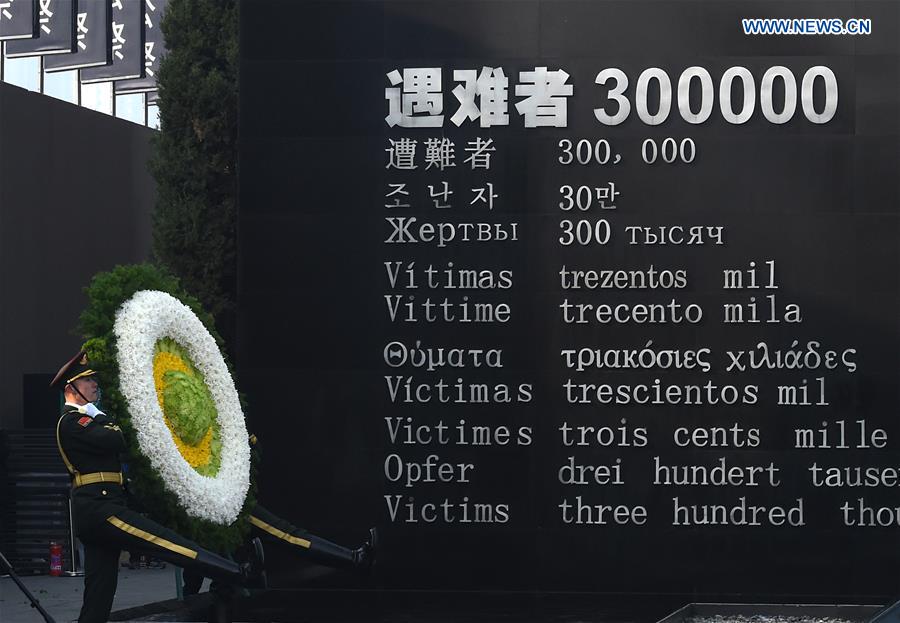
Honor guards lay a wreath at the state memorial ceremony for China's National Memorial Day for Nanjing Massacre Victims at the memorial hall for the massacre victims in Nanjing, capital of east China's Jiangsu Province, Dec. 13, 2018. (Xinhua/Sun Can)
NANJING, Dec. 13 (Xinhua) -- Sirens wailed throughout Nanjing, in eastern China's Jiangsu Province, on Thursday, as the nation marked its fifth national memorial day to commemorate the victims of the Nanjing Massacre.
On this day 81 years ago, Japanese troops captured Nanjing, then China's capital, and embarked on more than 40 days of slaughter. About 300,000 civilians and unarmed Chinese soldiers were brutally murdered, and over 20,000 women were raped.
More than 8,000 people convened in the main venue of the national memorial ceremony in the front of the Memorial Hall of the Victims of the Nanjing Massacre by Japanese Invaders in the city on Thursday.
At 10 a.m., the city came to a halt, as pedestrians paused and drivers stopped their cars and honked their horns to echo the sirens. People stood in silence for a one-minute mourning period.
The provincial legislature has legislated details on the city-wide one-minute mourning on the national memorial day, which took effect on Thursday.
The national memorial ceremony included activities such as teenagers' reciting poems of peace, striking the Bell of Peace and releasing doves.
On Thursday, World War II memorial museums across China held commemoration activities to synchronize Nanjing's peace-praying efforts.
LESS THAN 100 SURVIVORS
On a memorial wall inside the hall, 26 names were newly inscribed this year to bring the total number of identified victims killed in the massacre to 10,664 on the wall.
With no tombs to sweep for their deceased relatives, many family members of the victims of the 1937 Nanjing Massacre came to the memorial wall to mourn their loved ones. The wall, set up in 1995, is also known as the wailing wall.
Earlier this month, two Nanjing Massacre survivors passed away. In total, 20 witnesses of the atrocity in the city passed away this year, according to the memorial museum. There are less than 100 survivors of the massacre.
The Chinese government has preserved the survivors' testimonies, recorded in both written and video documents. The documents on the massacre were listed by UNESCO in the Memory of the World Register in 2015.
Wang Chen, a member of the Political Bureau of the Communist Party of China (CPC) Central Committee and vice chairman of the Standing Committee of the National People's Congress, addressed the ceremony on Thursday, saying the annual ceremony is meant to proclaim the Chinese people's firm stance on remembering history and cherishing peace while looking to the future.
China's endeavors in remembering the massacre has helped increase international attention to what happened in China during World War II.
American photographer Chris Magee took part in a peace rally weeks before China's national memorial in Nanjing. The activity, which has been held for three consecutive years, draws over 300 international peace lovers every year for a two-hour walk in the former Nanjing Safety Zone.
During the war, foreigners including Chris' grandfather, priest John Magee, saved more than 250,000 Chinese refugees in 25 shelters, which are now historical sites, in the zone.
Chris said that reflecting during the event made him feel more proud about what his grandfather did for the Chinese people during the war. He wanted to follow in the footsteps of his grandfather, using a camera to record changes in China.
In 2002, John Magee's son donated a camera that the senior Magee used to record the events in China to the Memorial Hall. The camera and its footage became an important part of the Documents of the Nanjing Massacre that were inscribed on UNESCO's Memory of the World Register.
"FLOWER OF PEACE"
Though spring is yet to come, Chinese netizens are forwarding a special image of violet orychophragmus, nicknamed purple grass, a symbol of peace, via social media outlets. It has become a tradition that in December, mourners in Nanjing wear "purple grass" badges, purple ribbons are tied in schools and families plant the purple grass in hopes for it to blossom in spring.
The flower blossoms in spring providing a flame of reddish-purple in Nanjing.
In 1939, a Japanese doctor surnamed Yamaguchi, who had been commissioned in Nanjing, brought the flower to Japan with a will of peace and named it "Shikinsou" (purple-gold-plant).
For decades after the war, the whole Yamaguchi family has been devoted to planting and promoting the flower. "Shikinsou" has become the flower of peace in Japan.
During China's first national memorial in 2014, an initiative dubbed "Purple Grass" was implemented by the Nanjing Television Broadcast Group to mourn the victims of the Nanjing Massacre. The organizer designed the badge with the flower's image of four purple petals with a yellow bud in the center.
The badge, anadem and other items in purple have become special tokens for the memorial. The activity has attracted 140 million netizens in the past five years to spread "seeds" of purple grass all over the world.
During the past 81 years, the city of Nanjing with its historical landmark of grand Ming Dynasty city wall has stood up from the war ruins, transforming into a technology innovation center.
In April, Turing Award winner Yao Qizhi based his Turing AI research Institute in Nanjing. In November, Cambridge University inaugurated the Nanjing Center of Technology and Innovation to research technologies in support of developing future smart cities.
"May the city that suffered the holocaust glow for the spirit of peace," said Chris Magee, when attending Thursday's memorial ceremony.
China and many other Asian nations have repeatedly denounced right-wing Japanese of whitewashing the country's militarist past. People of Nanjing are still sensitive about the trauma that occurred in the winter of 1937, describing it as a bullet hole on the ancient wall.
Zhu Chengshan, the former curator of the Memorial Hall, published a book entitled "A Hundred of My Japanese Friends" this month, with stories and photos recording how he made acquaintances with the Japanese during his tenure as the museum curator.
"My Japanese friends include journalists, lawyers, entrepreneurs, artists, politicians and veterans. No matter what they do, they agree to face the wartime history squarely and devote themselves to the peace cause and friendship ties between the two nations," said Zhu.
Zhe said one of his friends, Hiroshi Tanaka, professor emeritus at the Hitotsubashi University in Japan, has focused his research on the Nanjing Massacre.
This year, the Institution of Nanjing Massacre History and International Peace has opened 30 topics for international research on the massacre. Projects approved by the academic committee will receive support from the Instituion.
Peter Harmsen from the University of Copenhagen in Denmark has submitted his thesis, in which he compared Bernhard Arp Sindberg from Denmark who helped save up 20,000 Chinese from the Nanjing Massacre with a Danish leader who fought against German invasion during the WWII.
Harmsen said he noticed the subject after more and more literature on the Nanjing Massacre appeared in the Western world.
"Sindberg's deeds had long been ignored from 1940 to 2010, reflecting the limitation of the public cognition on some massacres during the WWII," he said.
(Video reporters: Xia Peng, Lin Kai, Wu Xinsheng; Video editors: Zhao Yuchao)
