




 ?
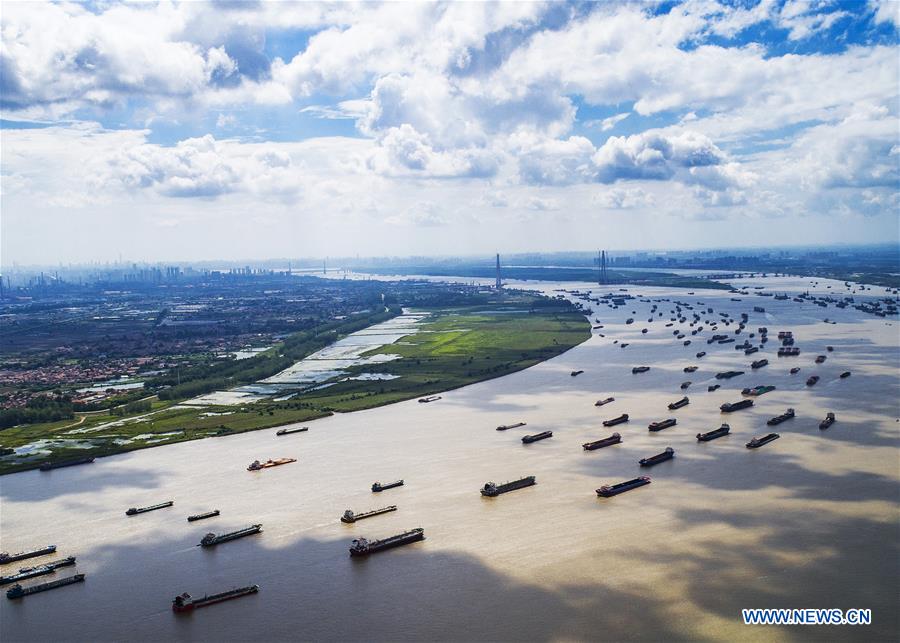
?Aerial photo taken on Aug. 13, 2018 shows ships sailing on the Yangtze River near Yangluo Port in Wuhan, capital of central China's Hubei Province. (Xinhua/Xiao Yijiu)
CHONGQING, Jan. 5 (Xinhua) -- Huang Caixian likes to hang his wet laundry to dry under the sun, but he only started doing this last year.
"The air used to be filled with coal dust. I would have been a fool to leave my laundry out to dry," said Huang, who lives in Chongqing Municipality along a tributary of the Yangtze, China's longest river.
A coal dock near his home was shut down in July last year, part of a large-scale environmental cleanup that has been carried out along the Yangtze River, the third longest in the world after the Nile and the Amazon, during the past three years.
Three years ago, Chinese President Xi Jinping presided over a meeting on the Yangtze River Economic Belt, which unveiled a new chapter for the conservation of the river and coordinated and innovation-led development.
The aim is to build the economic belt into a golden economic belt featuring more beautiful ecology, smoother transport, a more coordinated economy, a better-integrated market, and more scientific mechanisms, President Xi said in April last year.
MORE CONSERVATION EFFORTS
"The belt is the first regional strategy that prioritizes green development. It puts a rein on the uncontrolled exploitation of resources and aims to restore harmony between man and nature. It has brought about profound changes," said Wu Chuanqing, director of the regional economic integration center at Wuhan University.
The Yangtze River Economic Belt covers 2.05 million square kilometers, stringing up 11 provinces and municipalities from west to east, with Sichuan, Guizhou, Yunnan and Chongqing in the upstream, provinces of Hubei, Hunan and Jiangxi in the middle reaches, and Anhui, Jiangsu, Zhejiang, and Shanghai in the lower reaches.
Over the past decades, the Yangtze has provided freshwater for people and nurtured leapfrog industrial development during China's reform and opening up. The riverbank used to be studded with steel mills and petrochemical companies, which took advantage of cheap water transport. Statistics show that in 2016, sewerage discharge into the river was 35.3 billion tonnes, about 46 percent of China's total.
On the bank, wetlands were shrinking, and pollution reached a dangerous scale. In the river, water quality deteriorated and fish were disappearing. The dire situation called for a holistic approach such as the Yangtze River Economic Belt strategy to target the root of the river's problems, officials and researchers said.
In the past three years, dozens of new policies and regulations have been put in place. Facelift changes happen almost every day on the riverbank.
More than 1,254 illegal wharves have been dismantled in the past three years. Boat restaurants that once sold cooked fresh carps were shut down. Since 2017, fishing has been banned in all 332 nature reserves along the river. Large quantities of fish fry have been released to boost fishery resource.
"Lots of fishermen need to change their jobs," said Zhao Yimin, deputy director of the Yangtze River Fishing Supervision and Administration Office under the Ministry of Agriculture and Rural Affairs.
Jiangsu Province, bordering Shanghai, closed 6,000 chemical firms in the last three years. In a concerted effort, Chongqing aims to remove all companies which have dilapidated equipment from the river by 2020.
"The most remarkable change in the past three years is the growth of awareness in river conservation," said Li Xiuwu, vice mayor of Huangshi, a middle-reaches city on the Yangtze.
"We are making all-out efforts to protect the river, and refrain from excessive development. This has become a solid consensus," he said.
INTEGRATION AND COORDINATION
The economic belt, held high as a national strategy and a task that carries political weight, is a priority for government officials.
Shanghai, Jiangsu, and Zhejiang are making policies to share data on pollution and river transportation, and pool resources for entrepreneurship. Upstream provinces of Yunnan, Guizhou, and Sichuan have established special funds to finance conservation efforts.
The National Development and Reform Commission will coordinate the development of five major industries along the river - electronics and information, high-end manufacturing, auto, electronic appliances, and garments. The industry layout will be planned with full consideration of their environmental impacts.
Several inter-provincial infrastructure projects are planned. A four-billion-yuan (about 635 million U.S. dollars) project is underway to build levees and allow bigger freight liners to sail from Anqing to Wuhan, about 386.5 km upstream.
The depth of water, which is now 4.5 meters, will be raised to six meters to accommodate 10,000-tonne ships.
NEW INDUSTRIES
Xu Xianping, a counselor for China's State Council, said some cities in the belt have successfully emerged from pollution woes and struck a balance between economic development and environmental protection.
He cited the example of the city of Suzhou, where a blue algae outbreak in 2007 cut off water supply. Suzhou has shut down 3,060 companies that were heavy polluters in the last ten years.
Another city Zhuzhou, once a metal smelting base, has found new vitality in railway transport and auto and aviation industries, Xu said.
"Quality growth is the ultimate key to the development of the Yangtze River Economic Belt. It requires innovation in technology and management. Companies should invest more in R&D and bringing in talent," he said.
Differentiation in economic positioning for different provinces helps reduce competition. Shanghai has developed autos, electronics, aviation, and pharmaceutical industries. Wuhan is focusing on information technology, health, and intelligent manufacturing. Chongqing is eyeing new energy, artificial intelligence, and semiconductor-making. In the upstream provinces, where the environment is more vulnerable, agriculture and tourism are the priorities.
"We must coordinate environmental conservation and economic development. Clean water and lush mountains are priceless assets. Areas that have upheld this philosophy are gaining vitality in quality growth," said Zhang Yansheng, the lead researcher with the China Center for International Economic Exchanges.
(Reporters: Fan Junwei, Ding Chunyu, Yao Yu and Cheng Ji'an; video editor: Cao Ying)
