




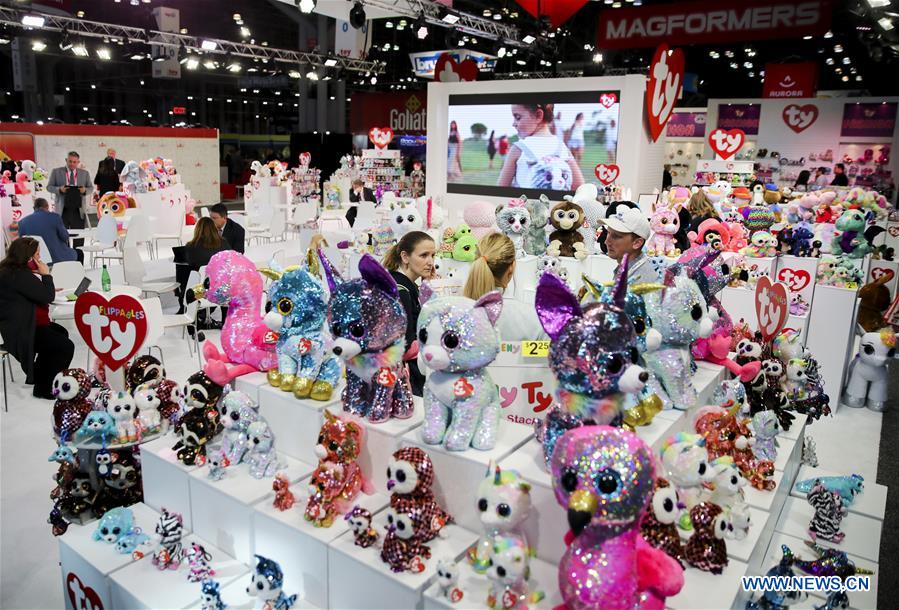
Visitors look at stuffed toys at the booth of Ty Inc. during the 116th Annual North American International Toy Fair at the Jacob K. Javits Convention Center in New York, the United States, on Feb. 19, 2019. (Xinhua/Wang Ying)
by Xinhua writers Yang Shilong, Luo Jingjing, Liu Yanan
NEW YORK, Feb. 26 (Xinhua) -- Bob Grubba sounded much happier and much relieved about his business prospects on Monday, a day after the latest round of U.S.-China trade talks yielded "substantial progress."
The founder and CEO of Choo Choo Shoes, a manufacturer for fun kids' shoes that make train sounds, made a throat-slitting gesture to himself when asked by Xinhua at last week's New York Toy Fair what would happen to his business if the next tranche of tariffs is to be imposed on goods imported from China.
"(The) progress is good. It's good for us. It's good for our suppliers. And I imagine it's good for everybody else in the industry, both in China and in the U.S.," Grubba told Xinhua via phone from his office at Ormond Beach, Florida.
"TO PUT TRADE TENSIONS BEHIND US"
After months of escalating trade frictions with the United States slapping massive extra tariffs on Chinese imports and China responding with retaliatory measures, Chinese President Xi Jinping and his U.S. counterpart Donald Trump agreed in Argentina in December that the two countries should strive not to impose additional tariffs before reaching a mutually beneficial agreement at an early date.
As part of their efforts in implementing the important consensus reached by the two leaders, Chinese and U.S. negotiators wrapped up the latest round of trade talks with substantial progress on specific issues on Sunday in Washington.
Trump later tweeted that he "will be delaying" the increase of tariffs on Chinese imports scheduled for March 1, citing "very productive" trade talks between the two teams.
"I'm glad to see the progress ... we can put the trade tensions behind us. And people from both countries can go on doing business and making money without (extra) tariffs," Grubba said.
Imposing more tariffs on China would cripple the business of small U.S. toy companies including Choo Choo Shoes that have made many success stories with their Chinese partners during the past decades, he said.
According to him, most of these companies have a profit margin in the range of 30 percent. If they were to pay a 25-percent tariff, it would only leave approximately 5 percent left to pay rent, insurance and other bills. "It's not enough," he lamented.
The Toy Association, a national trade association representing U.S. toy industry, welcomed the positive results of the bilateral trade talks on Monday.
"We are hopeful that a long-term trade deal is reached ... (and) removes tariffs which are costing U.S. businesses and consumers every day," Rebecca Mond, vice president of federal government affairs for the association, told Xinhua.
The industry group has more than 1,000 members, with 95 percent of whom are small businesses.
Josh Selig, president of Little Airplane Productions (LAP), also echoed Grubba and Mond's upbeat mood. "I believe we'll all be celebrating very soon in the U.S. and in China!" said the New York City-based award-winning TV producer.
LAP, which has been very active in China in recent years, made history in 2015 when Disney Junior U.S. acquired P. King Duckling, a series that LAP created and produced with China's UYoung Media. The deal was Disney's first ever acquisition of a Chinese animated series.
HARD TO MOVE BUSINESS OUT OF CHINA
Though toys have largely not been included in the tariff lists issued to date, many U.S. toy companies have been impacted by the tariffs that are currently in place, Mond said.
"They're really hurting small businesses across the country," she said, adding the tariffs on silicone, aluminum, dyes and other toys inputs have already increased costs of local toymakers.
The tariffs are "not the tool to be used" in tackling the disputes with China, a critical partner for the U.S. toy industry that supports about 700,000 U.S. jobs, she said.
U.S. market size for the total toy industry is approximately 28 billion U.S. dollars, according to the Toy Association.
While about 85 percent of American-sold toys are manufactured in China, 80 percent of the purchase price of the average toy remains in the United States because toymakers do research, development, design, and testing in America.
The idea to relocate production out of China is also unrealistic, Mond said. It is hard for toy industry businesses to find another country with comparable infrastructure, skilled workers, as well as the research and development capabilities.
Reyne Rice, a toy industry expert in New York City, couldn't agree more.
"China has been a crucial part of global toy supply chain for over a decade. Chinese toy producers are also doing better jobs in toy innovation and design, with their comprehensive global competitiveness advancing," Rice said.
Statistics show that China exported 44.15 billion U.S. dollars of toys in 2017, accounting for over 70 percent of total toys for sale in the world.
"It's difficult to move a factory (out of China) because our product is very specialized. It took us a long time to train the workers at the factories and train the engineers and get the quality the way it's supposed to be," Grubba said.
He also downplayed the option of a price hike. "If we were to increase the price, try to pass that cost onto our customers, I don't think they would pay it. I think we would sell less."
"First and foremost, trade wars never work, and everybody ends up a loser in a trade war," Mond said.
NO COMPANY CAN AFFORD TO LOSE CHINESE MARKET
After all, none of the U.S. toymakers, large or small, can afford not to be in China that is in most areas, either the world's largest market, or will become the world's largest market, industry insiders said.
"Certainly China has a great market opportunity, and it's largely untapped by U.S. companies. So certainly we hope to have greater market access and greater opportunities to sell over in China," said Mond.
China's improving economic structure, accompanied with its strong consumer spending power, unleashes huge potential for economic growth. With China's GDP reaching over 90 trillion yuan (about 13.28 trillion dollars) in 2018, consumption contributed more than 76 percent to the growth.
As the second largest toy market in the world, China has 236 million kids aged zero to 14 and 76 percent of Chinese urban population is expected to become middle class by 2022 with higher disposable income and expense, McConnell said.
For Selig, there is a natural synergy between Chinese and U.S. creators working together on global IP. "So to me, it's a win-win if we work together; if we separate, both sides lose," he said.
The establishment of Alpha Group US in 2016 is an effort of the leading Chinese animation and toy conglomerate to fully develop the American market.
"We have excellent operating and engineering teams with deep knowledge and rich experience in China, and we combine these with new ideas of marketing and design to exploit both markets," said Glenn Yu, design director of Alpha Group US.
Ty, the world's largest producer of stuffed plush toys, officially stepped into the Chinese market in late-2017 and sold some 2.5 million stuffed plush toys last year.
"We can see that China's business environment has become more favorable for foreign brands, and they are having more confidence as well," said Maggie Qiu, general manager of Deyi, the sole distributor of Ty in China.
(Video editor: Liu Yuting)
