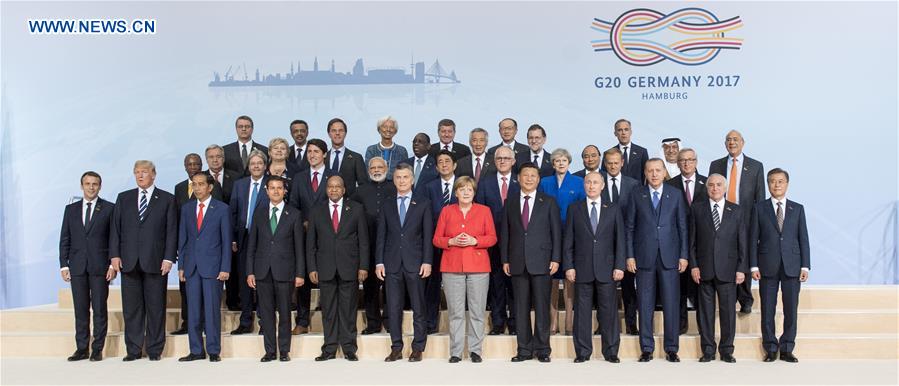
Chinese President Xi Jinping and other leaders attending the 12th Summit of the Group of 20 (G20) major economies pose for a group photo in Hamburg, Germany, July 7, 2017. (Xinhua/Li Xueren)
HAMBURG, July 10 (Xinhua) -- The summit of the Group of 20 (G20) in Hamburg has concluded with better-than-expected outcomes. Although the negotiations were not always smooth, the result was basically "satisfying" with consensus reached on a variety of issues.
For instance, the G20 members unanimously voiced support for globalization, opposed trade protectionism, committed themselves to open markets and decided to establish a stable international trade system to promote transnational investment.
However, differences were highlighted as much as the consensus that was achieved at the summit.
"You can notice that controversies within the G20 are substantial about trade and climate change, even about multilateralism itself," said Dr. Dirk Messner, director of the German Development Institute and co-chairman of Think 20, a think tank for the G20.
German Chancellor Angela Merkel conceded at a press conference following the end of the summit that negotiations on free trade proved to be very difficult.
Shi Shiwei, a professor from Free University of Berlin who specializes in China-Germany economy and trade, said that it was indeed "a major achievement to forge a consensus on free trade at the Hamburg Summit when the United States explicitly underscores trade protectionism and adopts an 'America First' policy."
But Shi also pointed out it's not hard to see rifts and compromises among various parties from the communique adopted at the conclusion of the two-day meeting.
On trade and investment, the communique said the G20 leaders pledge to "recognize the role of legitimate trade defense instruments in this regard." Commenting on this, Shi said, "this is a compromise made to U.S. President Donald Trump."
In the meantime, where combating climate change is concerned, different camps remain within the G20 bloc and the divides there are hard to bridge.
The communique pointed to the U.S. decision to pull out of the Paris Agreement while the rest of the G20 members described the pact as "irreversible" and reaffirmed their commitment to the climate deal.
The Financial Times commented that the "unanimous G20 communique fails to hide U.S. tension," saying the G20 nations put on a face-saving show of unity by negotiating a joint declaration despite the deep divisions on trade and on climate change driven by Trump's "America First" approach.
"The 'Trump effect' will become the biggest uncertainty for global governance in the future," Shi said.
At the summit Trump did not make much concessions on such issues as globalization and climate change and maintained his basic stand, Shi said.
While Trump was left somewhat isolated in Hamburg and was even positioned on the left fringe of the "family photo," the anti-globalization trend that prevails in Trump's administration, the United States as well as the world at large is not on the ebb.
German local media outlets believe this willful president will surely make more trouble for future global governance. Some are concerned the wording of "legitimate trade defense instruments" included in the communique poses the potential threat that some countries may impose punitive duties under that excuse, like a 20 percent tariff now being considered by the Trump administration against steel imports.
True, the world faces far more challenges than that. Volatility in financial markets, climate change and imbalances and unfairness in development remain problems confronting global governance, said Messner.
An unreasonable global financial architecture and lack of coordination in governance bring many risks and challenges to global governance, Shi added.
However, despite all the divisions, the G20 is still playing a crucial role in global governance.
"The G20 is even more important, and we need to rebuild it," Messner said.
The G20 represents 80 percent of the global gross domestic product (GDP), 80 percent of global trade and 80 percent of global resources and consumption. "If the G20 can't solve our global problems, no one else can solve them," Messner said. "They are responsible."