




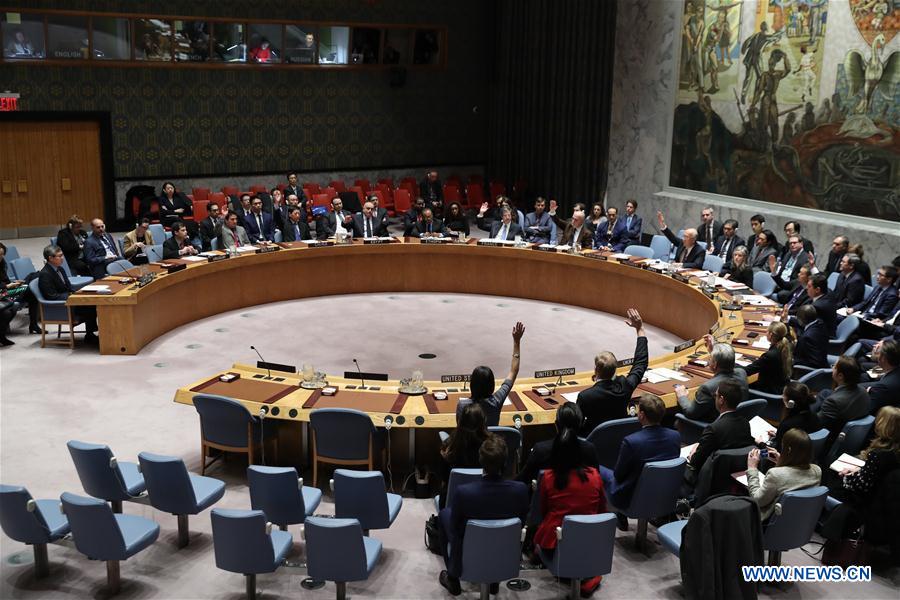
Photo taken on Dec. 22, 2017 shows theUnited Nations Security Council voting on a resolution on the Democratic People's Republic of Korea (DPRK) at the UN headquarters in New York. The United Nations Security Council on Friday adopted a resolution to tighten sanctions against the DPRK. (Xinhua/Wang Ying)
by Xinhua writer Wang Jiangang
UNITED NATIONS, Dec. 25 (Xinhua) -- Looking back on the year of 2017, the United Nations, while trying hard to uphold international peace and security and committed to global governance, has withstood strains of severe traditional and non-traditional challenges and threats.
In the face of multiple unprecedented challenges and threats as well as snowballing difficulties of global governance, the vast majority of the UN member states are rallying around the lofty ideal: making the world a better and safer place to live.
TOP CONCERN: TENSIONS ON KOREAN PENINSULA
In addition to augmenting traditional challenges and threats, non-traditional ones functioning as terrorism and extremism, nuclear crisis, trans-boundary crimes, refugee crisis, drug trafficking, climate change, cyber security and other global problems are running rampant, posing severe threats and challenges to the world.
Among them, the nuclear crisis on the Korean Peninsula has been recognized as the top security concern of the year, disturbing the relations among major powers.
Tensions on the Korean Peninsula have reached an unprecedented level in 2017 due to a nuclear test and multiple missile launches by the DPRK and constant U.S.-South Korea joint military drills.
The crisis has also been worsened by the exchange of personal insults and confrontational rhetoric raising the specter of war between the United States and the DPRK.
UN Secretary-General Antonio Guterres said on Dec. 15 that he was deeply concerned over the risk of military confrontation on the Korean Peninsula.
Describing the situation on the Korean Peninsula as "the most tense and dangerous peace and security issue in the world today," he warned: "Any military action would have devastating and unpredictable consequences."
In 2017, the DPRK conducted activities related to its nuclear and ballistic missile programs "at an alarming and accelerated pace," he said, adding that over the year, the DPRK conducted 20 ballistic missile launches.
On Sept. 3, the DPRK conducted its sixth nuclear explosive test, involving what it claimed was a "two-stage thermo-nuclear weapon," he added.
UN Under-Secretary-General for Political Affairs Jeffrey David Feltman visited the DPRK on Dec. 5-8, the first in-depth political exchange of views between the UN Secretariat and officials in Pyongyang in almost eight years. But the visit seemed to have produced little positive results.
In response to the crisis, the Security Council has once and again called emergency meetings over the year to discuss ways and means in the hope to contain the development of the situation.
The Security Council on Dec. 22 unanimously approved new sanctions targeting DPRK's economy following the launch of a ballistic missile on Nov. 29 that the DPRK said it could target the entire continental U.S.
The new restrictions were meant to slash the DPRK's imports of refined petroleum products, further restrict shipping and impose a 24-month deadline for expatriate the DPRK's workers to be sent home.
The secretary-general welcomed the continued unity of the Security Council, which is essential to achieve the goal of denuclearization and create the space for diplomatic initiatives aimed at achieving it in a peaceful manner.
MANIFOLD OTHER CHALLENGES, THREATS
UN statistics show that an unprecedented 65.6 million people around the world have been forced from home. Among them are nearly 22.5 million refugees, over half of whom are under the age of 18.
There are also 10 million stateless people who have been denied a nationality and access to basic rights such as education, healthcare, employment and freedom of movement.
In a world where nearly 20 people are forcibly displaced every minute as a result of conflict or persecution, said the UN Refugee Agency.
The world's fastest growing refugee crisis evolved in Myanmar. Driven by violence and human rights abuse, more than 600,000 stateless Rohingya fled to Bangladesh, where the fragile infrastructure is overwhelmed. The UN scaled up emergency aid and called on Myanmar to end military operations against the Rohingya.
In Yemen, 8.5 million people are on the brink of the world's largest famine in modern times. Water and sanitation systems are all but destroyed, sparking a deadly cholera outbreak. The UN sent in emergency supplies and urged all parties not to block civilians from humanitarian aid.
Four famines, in Yemen, South Sudan, Somalia and Nigeria, are the result of unresolved conflicts exacerbated by droughts and missed harvests.
In the deadliest attack on a UN peacekeeping mission in decades, 14 Tanzanian peacekeepers lost their lives in the Democratic Republic of the Congo.
"It is another indication of the enormous sacrifices made by troop contributing countries in the service of global peace," said the UN chief.
In Syria, six years of conflict have left 250,000 people dead and 5 million displaced. Temporary ceasefires were brokered and the UN's special envoy for Syria has been working tirelessly to bring the parties to the negotiating table and for an end to the war.
Almost 100,000 migrants crossed the Mediterranean Sea in 2017, and more than 3,000 have drowned. Most are fleeing poverty and conflict in Sub-Saharan Africa.
More than a million people were waiting for a passage in Libya, caught in an endless cycle of abuse, exploitation and even slavery.
Around the world, 130 million girls are still not going to school, which is unacceptable, said UN Messenger of Peace Malala Yousafzai.
"If we want to go forward, we have to give education to girls and once you educate girls, you change the whole community; you change the whole society," said the 19-year-old Malala.
Shortly after the UN first Ocean Conference, a series of mega hurricanes cut a trail of destruction through the Caribbean. On some islands like Dominica, hardly a tree or house was left standing.
Scientists have already seen strong evidence that climate change magnified the strength of the storms and other natural disasters. Therefore, the UN called on countries to speed up the implementation of the Paris Climate Agreement.
At the end of the year, global anti-terrorist pressure has not been alleviated by the disintegration of the Islamic State, UN said. Terrorism in new forms is emerging in the "Post-Islamic Era," and global counter-terrorism faces new problems.
From suicide bomb attacks to storming of cities, from random attacks to the use the Internet, terrorist groups are developing themselves by making use of the divergence of the interests among countries, posing cutting challenges to the anti-terrorist abilities of all countries.
In June, the UN restructured its anti-terrorist architecture and set up a UN anti-terrorism office to coordinate a global effort to prevent violent extremism and other root causes of terror.
Strengthening counter-terrorism cooperation has become an international consensus, said the UN chief.
CHINA: MAINSTAY OF GLOBAL GOVERNANCE
In the face of accumulating threats and challenges, especially in the maintenance of unity of the United Nations, China has always paid attention to strengthening communications with other Security Council members and UN member states to effectively embody the concept of "wide consultation, joint contribution and shared benefits."
China respects and takes care of the concerns of developing countries and practices the right approach to justice and interests. China has played an objective, just and responsible role for developing countries.
The establishment of "a community with shared future for mankind" is a major innovation in China's diplomacy and has produced a broad and far-reaching international impact, observers say.
On Feb. 10, the concept of "a community with shared future for mankind" was first written into a UN resolution. On Nov. 1, the concept was reloaded into two UN resolutions.
Izumi Nakamitsu, UN under-secretary-general and High Representative for Disarmament Affairs, said that the UN welcomes China's strong commitment of multilateral diplomacy, which is the "community of shared future for mankind."
"The reference of 'shared common future,' I think it is a commitment that China is making globally to multinationalism in general," she said.
"China will continue to play a very critical role in terms of how they work with other nations in the platform of multilateralism, one very important platform for that is the United Nations," she added.
EMBRACE FUTURE AMID HOPES
Since taking office on Jan. 3, Guterres has been busy shuttling between countries, practising "good offices" among conflicting parties, attending international meetings now and then, and once and again urging countries to join efforts to realize the 2030 Sustainable Development Goals.
Over the year, he has been making tireless efforts to make sweeping changes to the UN in hope of forging a "more effective, flexible and responsible" world body to manage the crisis of the 21st century.
However, because of the contrasting interests of different countries and the diverse cultures, religions and ideologies, UN reform cannot be achieved overnight, observers say.
The United Nations, the 72-year-old world body, is bidding farewell to another extraordinary year. Observers have happily found that while facing common challenges and threats, the vast majority of UN member states have shown unprecedented consensus at such world concerns as nuclear issue on the Korean Peninsula, climate change, fighting terrorism and extremism and other major threats and challenges.
Although the unilateralism thoughts displayed by the United States are worrisome to some extent, observers say, solidarity and unity of the UN are gaining momentum. This undoubtedly is bringing new hopes to the United Nations, which still has a long way to go.
