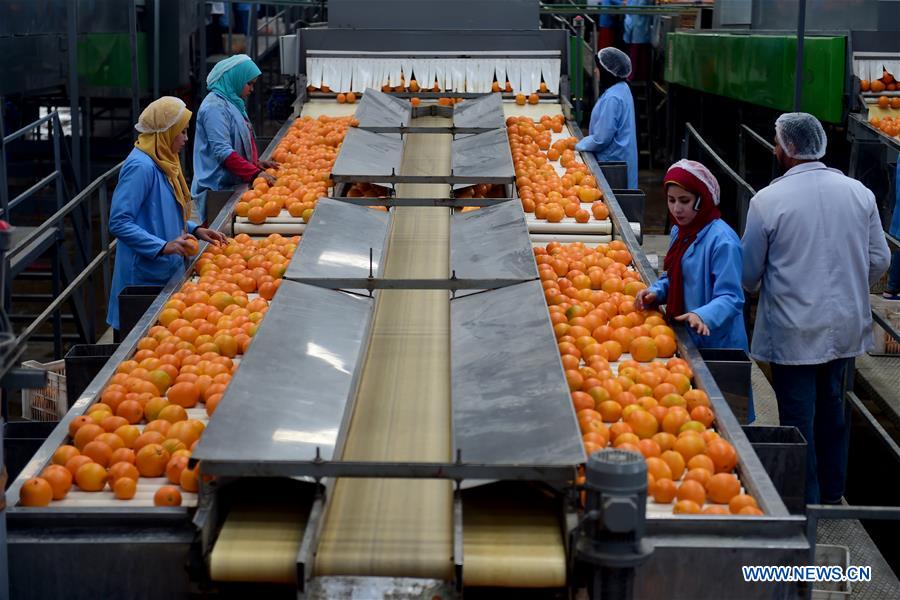
Egyptian workers pack oranges on conveyors inside a packhouse located in Beheira province, north of Cairo, capital of Egypt, on Jan. 24, 2018. Thanks to the fast-growing demand in China for quality fruits, Egypt has witnessed a rapid increase in its citrus exports to China in the past years, which has led many Egyptian citrus farms to prosper. Now Egypt, famous for producing sweet juicy oranges, has become the third largest exporter of citrus to China after South Africa and the United States. (Xinhua/Zhao Dingzhe)
by Mahmoud Fouly
CAIRO/BEHEIRA, Egypt, Jan. 31 (Xinhua) -- Thanks to the fast-growing demand in China for quality fruits, Egypt has witnessed a rapid increase in its citrus exports to China in the past years, which has led many Egyptian citrus farms to prosper.
Now Egypt, famous for producing sweet juicy oranges, has become the third largest exporter of citrus to China after South Africa and the United States.
"We began citrus export to China with over 23,000 tons in the first year in 2015, which then increased to more than 36,000 tons in 2016 and finally jumped to exceed 101,000 tons in 2017, which is more than three times increase since we started," said Mohsen al-Beltagy, chairman of Egypt's Horticultural Export Improvement Association (HEIA).
HEIA, founded in 1996, is in charge of selecting certified farms and arranging citrus exports to several parts of the world including European and Asian states in coordination with concerned agricultural authorities home and abroad.
"We inspect the farms and choose the best of them to export to China, in cooperation with officials from the Chinese Ministry of Agriculture who visit us here to see the farms," Beltagy told Xinhua at his office in Cairo.
HEIA also holds training programs for Egyptian citrus farmers to raise the quality of their fruits to be exported to China, Beltagy said.
Han Bing, economic and commercial counselor at China's Embassy in Cairo, noted that Egypt's orange exports to China hit 20 million U.S. dollars in 2015 and sharply increased to 80 million dollars in 2016.
"Chinese market is a big, open and highly-competitive. Our imports from all over the world will reach 10 trillion dollars in the next five years," Hang told Xinhua.
He said he expected to see further increase in the exports of Egyptian agricultural products to China in the future. "We help Egyptians improve the quality of products to reach our import standards and we expect to see more Egyptian agricultural products in the Chinese market," he said.
Maghrabi Agriculture (MAFA), one of Egyptian citrus farms approved for exports to China, exported 2,500 tons of oranges to the world's most populous country last year.
Stretched on a vast reclaimed desert area in the Beheira province to the north of Cairo, MAFA looked like a piece of art with its rows and rows of aligned citrus trees bearing shinning round-shaped golden fruits waiting to be harvested and sent to the packing facility before exporting.
"Each acre produces from 20 to 25 tons of citrus and we have around 5,500 acres in MAFA. We produce some 100,000 tons per year, about 90 percent of which is for export and 10 percent for the local market," said Arafa al-Sheikh, head of MAFA's citrus department.
He told Xinhua that MAFA takes great care of its citrus fruits from the early stage through well-managed fertilization, irrigation and chemical treatment.
"The citrus quality is completely based on biologic resistance, pest control, and most limited and timely use of approved pesticides. We take care of the products from beginning to end," the engineer said.
Inside MAFA's spacious packhouse, dozens of workers, all in white uniform, packed oranges on several conveyors after they were screened by an electronic sizer that separated them based on their size, color and defect degree.
Adel Qiritam, MAFA's general manager, said that MAFA uses Egyptian and foreign expertise, best post-harvest experts and advanced technologies to achieve the highest quality of its products to satisfy its clients.
"For instance, this is the second year for MAFA to use this electronic sizer, which detects all defects. The previous one only classified fruits according to their color and diameter. This one uses the color, diameter, size, external defects and everything to separate them," he told Xinhua in his office overlooking the packhouse's interior.
He noted that the company in general employs up to 5,000 full-time and part-time workers, and the number may increase as MAFA is currently building a packhouse for grapes to prepare them for exportation.
At two opposite production lines inside the packhouse, a group of workers have been packing oranges coming from conveyors into boxes. Other workers carried the packed boxes of fruits with forklifts to pile them up at a far corner of the packhouse to be sent to large coolers in preparation for shipment.
"Our hygienic and careful work is what makes us number one in quality," said Mona Mostafa Hassan, a packing worker in her early 30s, who has been working for MAFA for eight years.
"We put on our uniform every morning and sterilize our hands before we start working. Our supervisors and our production managers treat us very well, give us training and train newcomers as well," she told Xinhua.
Ibrahim al-Banna, MAFA's export manager, said that his company exports citrus to about 53 countries around the world, in a distribution strategy that diversifies its exports to offset possible risks of a market decline in certain markets.
"MAFA exported about 2,500 tons of citrus to China in 2017, and we plan to increase it up to 3,000 tons in 2018," Al-Banna said.
Banna said that Chinese importers have the highest demand for fruits' quality, even higher than the Europeans, with specifications including big size, round shape and soft skin fruits with maximum five percent of minor, non-developed defects.
"China rises as a very important market with very good potentials for Egyptian citrus exports. I expect Egypt's orange exports to China to gradually increase to higher levels in the near future," he told Xinhua.
Based on the success of citrus exports to China, Egyptian exporters are now working to increase exports of grapes and dates, another two local quality fruits, to China to meet the fast-growing demand there.