BEIJING, Feb. 3 (Xinhua) -- After decades of speedy advances, China is shifting its economic focus to high-quality development, with "developing a modernized economy" high on the agenda.
Now an economic catchphrase, the idea provides a blueprint for the world's second largest economy during the next five years and beyond.
It will be embodied in innovation-driven industries with coordinated development, an open and fair market, efficient and fair income distribution, coordinated urban-rural and regional development, energy conservation and environmental friendliness, and an open economy with higher standards.
Efforts will be made to give full play to the role of the market, while the government is expected to play a better part.
FOCUS ON REAL ECONOMY
The real economy, once outshone by rampant real estate prices and financial speculation, has again gained traction.
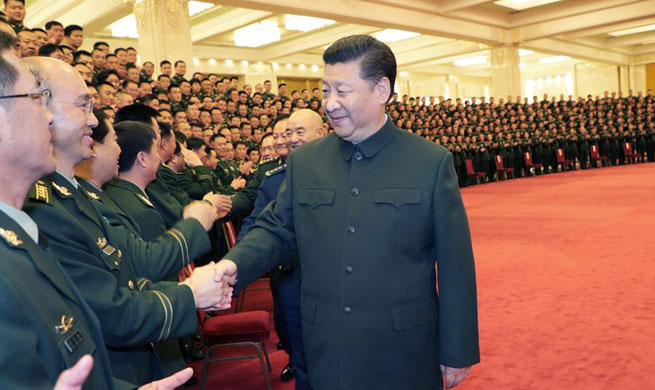
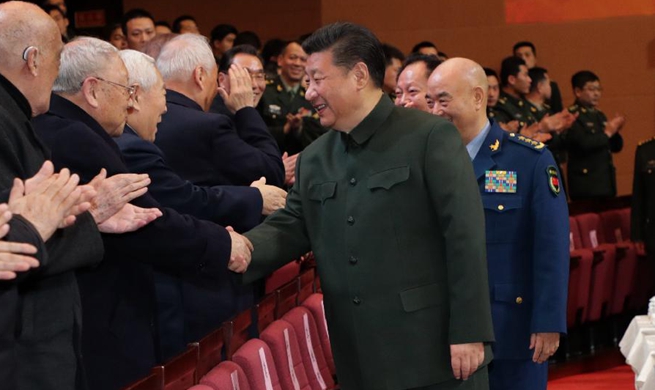
While presiding over a group study of the Political Bureau of the CPC Central Committee, General Secretary of the CPC Central Committee Xi Jinping described the real economy as the foundation of the modernized economy, advocating the use of new technology including the internet, big data and artificial intelligence to boost traditional industries.
To develop a modernized economy, China should channel more energy into improving the quality of supply and grow into a manufacturing powerhouse, said Wang Yiming, deputy director of the Development Research Center of the State Council.
The government has rolled out an array of measures such as "Made in China 2025" and "Internet Plus" strategies.
Funds that used to flow into the virtual economy due to high yields are returning to factories that produce tangible goods. New loans in the real economy rose 11.34 percent to 13.84 trillion yuan (around 2.2 trillion U.S. dollars) last year.
Thanks to rising investment, innovators sprouting up across the country are injecting new vitality into the economy. More homegrown tech firms are transforming from followers to leaders in the international tech community.
Technology is playing a bigger role in driving the economy. Tech is estimated to have contributed 57.5 percent to economic growth last year, up from 56.2 percent in 2016, according to Wang Zhigang, vice minister of science and technology.
OPENING UP OF HIGHER STANDARDS
During the group study, Xi called for a diverse, balanced, secure and efficient system for opening up on all fronts, with better use of global resources and markets and promotion of international cooperation under the Belt and Road Initiative.
As 2018 is the 40th anniversary of China's reform and opening up policy, the country's door to the world will only become more open.
At the World Economic Forum annual meeting in January, senior Chinese official Liu He said more measures are in the pipeline to further open the country's finance, manufacturing and service sectors, and step up protection of intellectual property.
The Chinese government has been striving to ease market access for foreign investment and build a level playing field for players from home and abroad.
Foreign direct investment in the Chinese mainland hit an all-time high of 878 billion yuan last year, with 35,652 foreign-funded businesses established.
China has promised to boost imports, announcing plans to purchase more than 10 trillion U.S. dollars of goods and services in the next five years. The first China International Import Expo will be held in Shanghai in November, which is expected to bring together thousands of enterprises from more than 100 countries.
Liu said China will make more efforts to cut tariffs on products including cars. Import taxes on 187 products were slashed last year, with the average rate down from 17.3 percent to 7.7 percent.
The Belt and Road Initiative is also an important part of China's opening up to the world.
Industrial cooperation under the Belt and Road Initiative will prompt a re-balancing of the world economy, said Zhang Yansheng, researcher at the China Center for International Economic Exchanges.
China's non-financial outbound direct investment (ODI) to countries involved in the Belt and Road Initiative totaled 14.4 billion U.S. dollars last year, 12 percent of the total ODI, up from 8.5 percent in 2016.
LET THE MARKET DECIDE
China's modernized economy will continue to be market-oriented and follow market rules, with stronger reforms to break barriers and bring vitality to the economy.
A market system that is unified, open, competitive and well-ordered is needed, Xi said during the group study, adding that China will give full play to the market and prompt a better role for the government.
One of the major tasks is the consolidation of state-owned enterprises (SOEs).
Debt-ridden and loss making state-owned "zombie companies" are reorganized via mergers and acquisitions or face bankruptcy according to market rules. Some have begun to carry out mixed-ownership reforms to improve competitiveness. Of the 19 state firms piloting the reform, seven have brought in more than 40 investors and the injection of over 90 billion yuan.
Meanwhile, the private sector will receive stronger support. At the 19th CPC National Congress, policy makers pledged to introduce a negative list for market access and do away with regulations and practices that impede fair competition.
The government has rolled out measures to build a sound business environment for the private sector, including less red tape, better services and lower fees and taxes. During the first three quarters of 2017, 4.51 million new businesses were registered, up 12.5 percent from a year ago.
More policies can be expected to protect property and the rights of private businesses, relieve their burdens and allow them to enter more key industries.