BEIJING, March 23 (Xinhua) -- China's Ministry of Commerce (MOC) on Friday urged the United States to "pause on the brink of a precipice" and make prudent decisions so as not to put bilateral trade relations in jeopardy.
Calling recent restrictive measures by the United States against China "a very bad precedent," an MOC spokesperson said the measures went against "the interests of China, the United States and the world at large."
China will not sit idly and watch its legitimate rights and interests be damaged under any circumstances, the spokesperson said.
"We are fully prepared to firmly defend our interests," he said.
Despite strong warnings from business groups and trade experts, U.S. President Donald Trump on Thursday signed a memorandum that could impose tariffs on up to 60 billion U.S. dollars of imports from China and restrictions on Chinese investment in the United States.
The memorandum is based on a Section 301 investigation, launched by the Trump administration in August 2017, into alleged Chinese intellectual property and technology transfer practices.
The move came after the U.S. administration took an increasingly hawkish turn on China, as it blamed its trade deficit with major trading partners for its domestic economic woes and job losses.
Despite worldwide objections, the U.S. government decided to impose a 25-percent tariff on steel imports and a 10-percent tariff on aluminum, with tariffs on imports from EU member states, Argentina, Australia, Brazil, Canada, Mexico and the Republic of Korea suspended until May 1, 2018.
The MOC reiterated its stance that it does not fear a trade war, although it said that it is the least desirable option.
"We have confidence and capability in dealing with any challenges," the MOC spokesman said in a statement on its website.
U.S. industries also strongly disagree with the sweeping tariffs.
"Tariffs could lead to a destructive trade war with serious consequences for U.S. economic growth and job creation. The livelihood of America's consumers, businesses, farmers, and ranchers are at risk if the administration proceeds with this plan," U.S. Chamber President and CEO Thomas J. Donohue said in a statement.
Robert Lawrence Kuhn, a leading China expert, said the measures will not solve America's economic problems and probably in the long term will make it worse, adding that this is because there are natural economic principles that are violated by heavy tariffs.
Minister of Commerce Zhong Shan pointed out that different statistical methods widen U.S. trade deficit with China by around 20 percent, citing the research of a joint work group tracking and comparing the two countries' trade figures.
China's trade surplus with the United States grew 13 percent year on year to 1.87 trillion yuan last year, official data showed.
The trade imbalance between the two countries is structural, with China exporting more commodities to the United States while importing more services, Zhong said, adding that trade competitiveness is determined by industries.
"Tracking a trade deficit is misleading. All that [trade deficit] means is that we in the United States consume more," said Tori K. Whiting, a research associate at Washington-based think tank The Heritage Foundation.
To address the imbalances, both countries should carry out structural reforms rather than just narrowing the trade deficit.
Regarding the U.S. investigation into China's protection of intellectual property rights (IPR), Wu Jianmin, an expert on China-U.S. relations, said China has made unprecedented efforts in the battle against IPR infringement. "What the Trump administration should do is to enhance bilateral communication on IPR protection, which will benefit U.S. enterprises without jeopardizing the China-U.S. relationship," said Wu.
There have been disputes between the world's two largest economies, but these should be resolved through explicit, sustainable and rational means, Wu said.
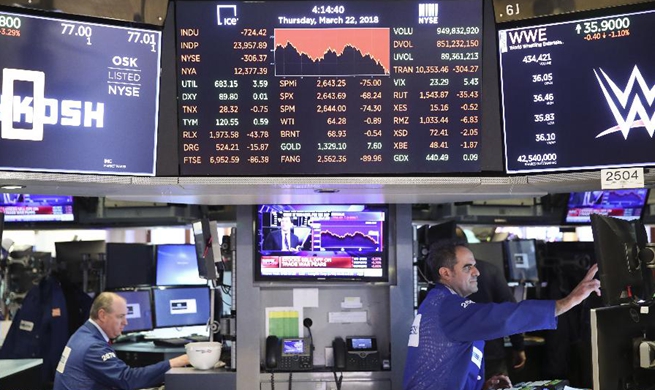
Chinese stocks closed more than 3 percent lower on Friday following the U.S. decision to hike tariffs on China's steel and aluminum imports.
The steel sector led the slump. The sub-index for the steel sector dived 6.2 percent. Anyang Iron & Steel and Xinyu Iron & Steel both plunged by the daily limit of 10 percent.