 ?
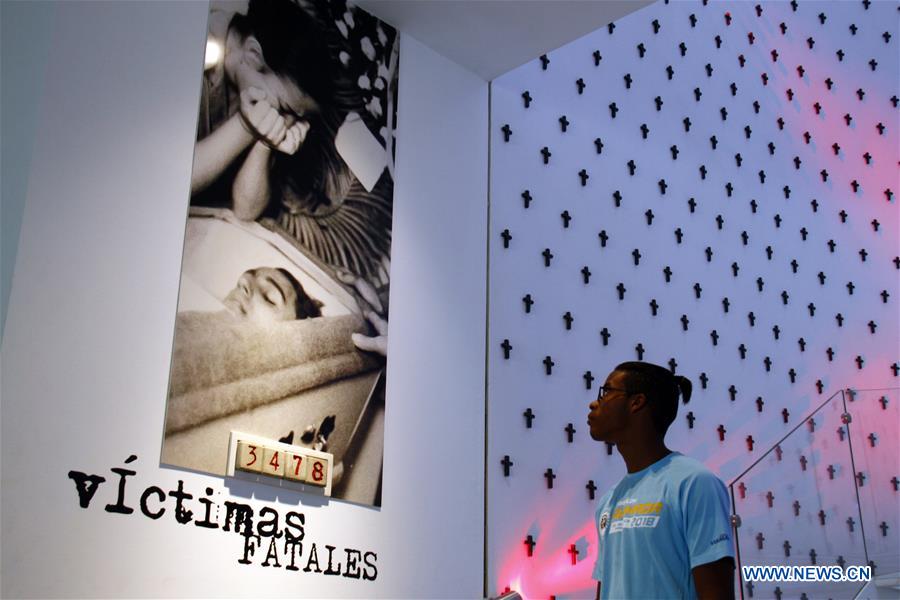
?A young man visits the museum of state security or "Memorial de la Denuncia" in Havana, Cuba, July 4, 2018.
by Xinhua writers Noemi Galban, Raimundo Urrechaga
HAVANA, July 14 (Xinhua) -- In one of Havana's stylish neighborhoods, three 20th century mansions are home to a particular museum which showcases the history of the Cold War confrontation between Cuba and the United States, as well as violence of extremist organizations against the island.
It's Cuba's museum of state security or "Memorial de la Denuncia" where the island, using traditional and hi-tech means, shows the decades of political confrontation with Washington and commemorates the victims of terrorist actions.
Reopened in August 2017, the memorial seeks to attract Cuban youth to a history that for most is part of the past, and also an essential way of knowing the reasons for the 50-year enmity between Cuba and the United States.
"It's a modern project designed for the youth with current technological breakthroughs. All visitors can appreciate U.S. aggressions to Cuba since 1959 and through six topics, understand the nature of the constant meddling Washington has done to our nation," Ileana Gell, the memorial's deputy director, told Xinhua.
As visitors walk into the memorial, they come face to face with 3,478 crosses placed on a wall, which represent the number of victims due to terrorist actions against Cuba.
"This is the place where we honor these victims," said Gell.
Before becoming the only technologically-based museum in Cuba, these buildings had been the headquarters of the country's state security apparatus between 1959 and 1962.
Hundreds of terrorist actions, assassination attempts against former president Fidel Castro and other plots were uncovered here by the agents of the nascent revolution, said Gell who is also the founder of the local institution.
In 1989, Castro inaugurated the State Security Museum on the 30th anniversary of this institution as a way for Cubans to appreciate all the undercover and silent work done by thousands of agents.
The museum boasts a unique, one-of-a-kind quality not only because of its technological advances, but also because it stands as a reminder and tribute to those who lost their lives defending the right to live in a sovereign Cuba, said President Miguel Diaz-Canel when he inaugurated the memorial last year.
"It has to do with the epic of the Revolution, because we have to understand, from the different approaches and expressions the museum offers, how a small country with great intelligence and heroism was able to confront these aggressions," said Diaz-Canel.
The museum closed its doors in 2010 when a capital renovation project began on the buildings that hosted the collection. Since re-opening, the memorial has received more than 52,000 visitors, who have learned about the recent history of Cuba in an entertaining, dynamic and interactive way.
"It's a new approach with a more contemporary language aimed at young people who use new technology very often. With a (new) conceptual design, it allows them to obtain information faster," museologist Ileana Corella told Xinhua.
"Through six leitmotifs including the Central Intelligence Agency and other intelligence services, media war, state terrorism, economic warfare and others, the visitors can see the extent of these aggressions," explained the memorial's deputy director.
Gell said the technological component is essential, since in addition to the well-known traditional objects that are usually found in a museum, other resources are used in order to enable and improve public interaction with the exhibits.
The visitors can find tactile screens on the walls with timelines, interactive infographics with historical facts, materials with holographic effects, films, even a sensory room with the smell of gunpowder.
"There is a constant use of symbols in each room that mark a historical context. Each artistic installation also has a symbolic meaning," said Corella, referring to the thousands of projectiles placed on the floor in one of the rooms.
Current generations of Cubans who regard history as part of the past, now have a place to learn about it through valuable museum pieces, documents, artistic work and interactive screens.
"It is very important to have a place like this so that it can be visited by both nationals and foreigners, and especially our youth," the deputy director of the institution said.?