YINCHUAN, Aug. 12 (Xinhua) -- Hai Guobao, 62, an ethnic Hui minority farmer, suffered from a lack of water in rural Xihaigu, northwest China's Ningxia Hui Autonomous Region, until he volunteered to be relocated to Minning Township in 2012.
"When I was young, I heard about the Yellow River from my elders, but I had never seen it myself and I could not imagine its yellow color," he said.
Xihaigu, an impoverished mountainous region in south Ningxia, is one of the world's most uninhabitable places, renown for its harsh environment.
"Droughts in summer, floods in autumn, and freezing cold in winter. We lived at the mercy of the climate." Hai said, poor harvests plunged the villagers into severe poverty.
From 2012 to 2017, about 10,000 residents from six villages in mountainous areas of Xihaigu chose to be relocated to Minning, over 300 km away from their ancestral homes.
Minning, located on the fertile plains, was a whole new world for the villagers from the remote mountains.
Before the ecological relocation program began, government officials showed them around in the township. Standing on a bridge, Hai and his neighbors saw the Yellow River and its muddy waters for the first time.
"In our hometown, our biggest concern was the lack of water," said Hai. Relieved and determined, all the 67 households in his village volunteered to move to Minning.
Months later, motorcades loaded with the villagers and their belongings headed for their new homes. Upon arrival, Hai immediately turned on the taps, listening to the sound of running water with delight.
FAREWELL TO THE CAVES
Hai and his fellow villagers once lived in caves, known as "yaodong," on the ridges of mountains.
Hugging the mountainside, the caves dotted the landscape. Visitors viewed them as the gifts of nature. But for those who lived in them, they represented life at its harshest.
"We stored our crops inside and slept near the mouth of the cave. The walls were all blackened by the smoke and dust," said Hai.
A stone bed with thin sheets was all they had in their bedroom. On rainy days, roads in the village became too slippery to walk on. "They were so muddy that old men like me could easily fall over," Hai said.
"I had lived there all my life, but I choose to leave for the sake of my grandchildren," said Hai.
Schools in Xihaigu had no desks and chairs, so students had no choice but to sit on the ground while writing. "Children had to walk for 3 to 4 km to get to school," added Hai.
In Minning, this is no longer the case. Hai's oldest grandchild walks 300 meters to get to his junior high school. "I hope my grandchildren can become the first college students in our family," Hai said.
HELLO TO CITY LIFE
At first, it was difficult for the relocated farmers to fit in. "Some chose to return to Xihaigu, but after a short time, they decided it was better to move here because of the rapid development in the town," said Xie Xingchang, a migrant from Wangmin Village in Xihaigu.
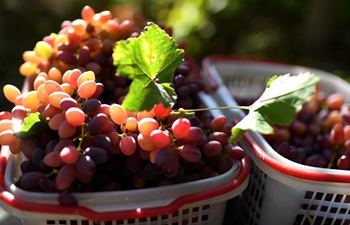
The local government built houses and facilities including schools, community hospitals, and shopping malls for the newcomers. With strong policy support, experts and enterprises from the eastern province of Fujian came to Minning and helped teach the farmers how to grow mushrooms, grapes and flowers. Free job training was also provided in order to help the farmers lift their families out of poverty.
In 1997, villagers like Xie earned about 500 yuan (73 U.S. dollars) a year on average. Now some 20 years later, he earns nearly 12,000 yuan a year.
"I was living in the countryside, but now I enjoy my life here in the township," Hai said.
In 2017, Hai was hospitalized for two weeks due to illness. The hospital told him not to worry about the money as medical insurance would cover most of the costs and he could pay the rest after recovery.
For Hai, the ecological relocation program has been a way to improve his quality of life and provide a better future for his family.
Those villagers who did not want to move to Minning were not left behind. The local government offered them opportunities to move to places with better living conditions in Xihaigu so that they don't have to say goodbye to their beloved mountains.