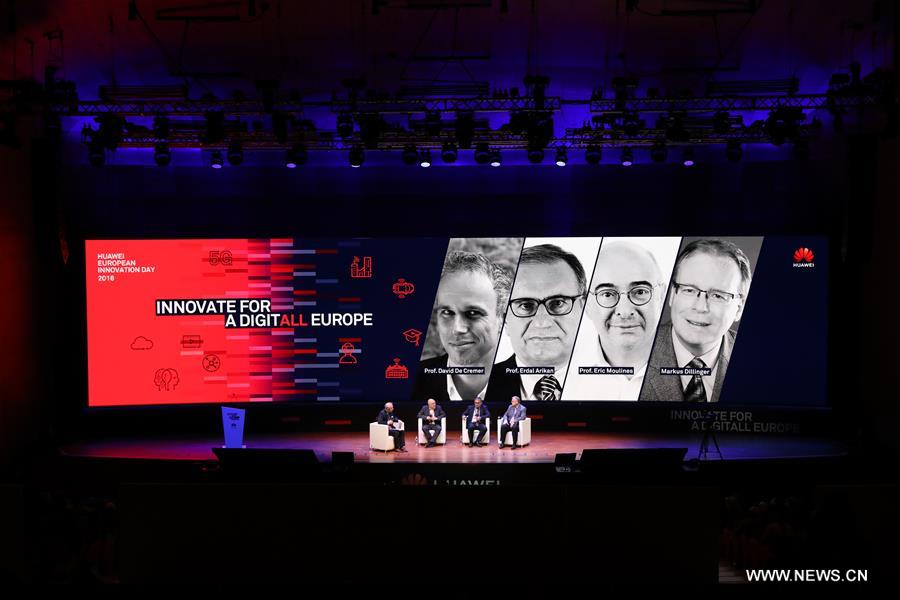
Experts take part in a group discussion during Huawei's European Innovation Day in Rome, Italy, Nov. 7, 2018. Information and communications technology (ICT) experts gathered to discuss innovations in the digital world and how they will shape the intelligent society of the future at Huawei's European Innovation Day, held at the Rome Convention Center La Nuvola (The Cloud) on Wednesday. (Xinhua/Cheng Tingting)
ROME, Nov. 7 (Xinhua) -- Information and communications technology (ICT) experts gathered to discuss innovations in the digital world and how they will shape the intelligent society of the future at Huawei's European Innovation Day, held at the Rome Convention Center La Nuvola (The Cloud) on Wednesday.
"Our vision is to bring digital technology to every person, home and organization so that they can fully connect in an intelligent world," Huawei Chairman Liang Hua told participants.
"Huawei has been in Europe for 18 years (but) our work in Europe is much more than just business," he explained.
"As they say, all roads lead to Rome, and ICT infrastructure is the foundation of those roads in the modern world," said Liang. "Huawei's focus is ICT infrastructure and smart devices, working to build digitalization in Europe and helping industry to prepare for an intelligent world."
Liang said that Huawei invests 15-20 billion U.S. dollars a year in research and development (R&D), with 20-30 percent of that amount going to basic research.
Without basic research, ICT would not exist today, he pointed out, adding that Huawei has "partnerships with over 120 universities and research institutions in Europe", including Oxford and Cambridge in the UK and Trinity College in Dublin.
The focus right now is on artificial intelligence (AI), which some say will be to the digital world what electricity was to the Industrial Revolution, said Liang Hua.
Mathematician and computer scientist Eric Moulines, a professor at the cutting-edge Ecole Polytechnique near Paris and a member of the French Academy of Sciences, delved into some of the challenges currently facing researchers in machine learning, one of the applications of AI.
"Machines are much less efficient at learning than humans, because they need millions of examples and require massive computational complexity," Moulines explained.
The revolution in machine learning, he said, was driven by "a dramatic increase in computing power and a dramatic increase in data sets" that the computer can choose from in order to "learn".
"Major drivers such as Huawei, Facebook and Google developed software and libraries that helped develop this sector," said Moulines.
He went on to explain that "most machine learning methods in use today are poor at representing uncertainty" and that "we need to make algorithms that are resistant to adversarial attacks", because all it takes is "a small perturbation" in a single pixel of information to make a machine mis-classify "pedestrians" as "an empty road", for example.
"I want to make systems which know that they don't know," said Moulines, adding he "started working on this problem 3-4 years ago".
The ultimate aim is to "build systems that make rational decisions and incorporate prior knowledge into learning systems -- something we still don't know how to train machines to do," said Moulines.
It will be very important to work out these kinks because in the digitalized world of the near future, "cars will have to make decisions", explained Markus Dillinger from the Huawei German Research Center headquartered in Munich, Germany.
"Future cars will have growing connectivity demands - from full driver control to fully automated urban driving and, once 5G (fifth-generation) wireless technology becomes available, driverless cars," Dillinger said in a speech about connected and automated mobility (CAM).
Future cars will be equipped with computer and radar vision, he explained, but they will require the surrounding infrastructure -- cities, roads and highways -- to be equipped with sensors and 5G sites.
The European Union is moving towards the creation of integrated infrastructure that will allow for automated driving across borders. "A pan-European network of 5G corridors is now emerging with hundreds of kilometers of motorways where tests will be conducted up to the stage where a car can operate itself with a driver present under certain conditions (third level of automation)," the European Commission announced in April 2018.
The EU has estimated the cost of 34,000 kilometers of digital highway at 5-7 billion euros (5.7-8 billion U.S. dollars), Dillinger explained, adding that the "first commercial 5G cars could be on all public roads by 2026".
Other speakers included award-winning Turkish Professor Erdal Arikan, who invented the so-called "polar code" underlying 5G wireless technology.
"Polar codes are the end result of more than 20 years of basic research, which began at the Massachusetts Institute of Technology (MIT)," said Arikan. "But their commercialization in the EU and Turkey were hindered by an interruption in funding in going from basic to applied research."
Like its predecessors (1G-4G), 5G will be able to channel voice, video, and data -- but at much faster speeds and while connecting a lot more devices at once, leading to the possibility of smart buildings, cities, and infrastructure, as well as large-scale industrial automation, Arikan explained.