 ?
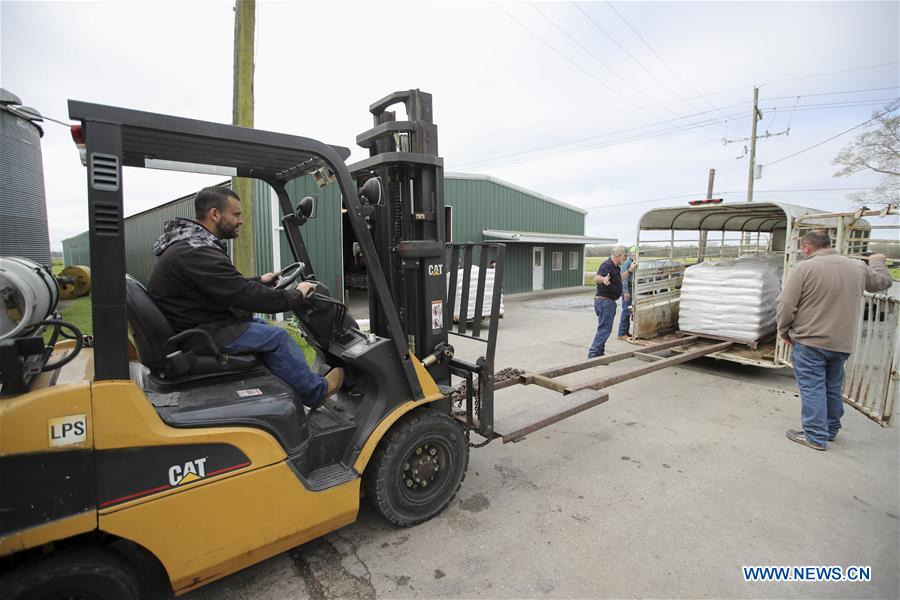
?A worker loads farm products to a buyer's truck at Ray Schexnayder's farm in West Baton Rouge Parish, Louisiana, the United States, March 1, 2019. Ray Schexnayder has never been to China, but his life has long been connected with the East Asian country.(Xinhua/Wang Ying)
by Xinhua writers Pan Lijun, Zhang Mocheng, Wang Ying, Gao Lu
BATON ROUGE, the United States, March 11 (Xinhua) -- Ray Schexnayder finds it as efficient as it is cool navigating a Chinese-brand flying camera to examine the health of his crops.
Applying this cutting-edge gadget to record the harvest season has become a highlight of his agricultural life.
The 60-year-old farmer from the U.S. state of Louisiana has never been to China.
But his life has long been connected with the East Asian country. "A lot of the stuff we buy is made in China," said Schexnayder.
More importantly, his business is closely related with China.
With some 3,000-acre farm stretching across the Pointe Coupee Parish to West Baton Rouge Parish in the southeastern U.S. state, his family business R. Schexnayder & Sons, LLC, is one among the largest in the neighborhood.
Launched in 1965, the farm has seven employees at peak time, and its major produces include soybeans, corn, oats and wheat, with soybeans growing on 2,200 to 2,400 acres, the pivot business.
China has been the biggest market of U.S. soybeans for many years, said Schexnayder, who has served at the United Soybean Board, a major U.S. soybean association, for nine years.
"We are all trying to open as many markets as we can ... by China buying beans, it does help to balance the trade imbalance," he said.
His business is very dependent on international markets. About 90 percent of the soybeans and about 40 percent of the corns are exports, with China being a big buyer for both, according to Schexnayder.
Located along the Mississippi River, Louisiana is one of America's earliest port hubs, serving as a major sea gateway for both export and import.
Farmers from the state and other Midwestern states transport grain to the grain elevators by truck, train, or by barges to the port area before reloading it onto ships.
Schexnayder's farm is just about 24 km from the closest grain elevator and about 48 km from the second closest one.
"We are so close to the Gulf of Mexico, the freight is a lot lower," said Schexnayder, who has been engaged in farming for 40 years, "so we can normally get a premium."
He said his family business, which is now self-financing, has benefited from a developing U.S.-China trade partnership over the years.
Compared with other crops, the cost to grow soybean is lower and with an average yield of 70 bushels per acre, farmers can make profits given a stable overseas market.
"If they have a real good year, that's the year they're going to buy a new tractor, a new pick-up, spend more on seed or try the newest technologies," said the experienced farmer.
Schexnayder has three planters, two combines, two trucks and eight tractors on the farm. He hopes to introduce more new stuff to help upgrade and expand his business as "everything is advancing so fast."
Last year, the yield of soybeans on his farm reached up to 71 bushels per acre. Schexnayder was delighted when talking about the record year in the family business's half-century history.
It could be the best one with the prices at the normal level. However, Schexnayder said the bean price for each bushel was about two U.S. dollars lower due to the global trade spat.
The farm grew 2,300 acres of soybeans in the past year, which translated to making 326,600 dollars less than usual, said Schexnayder.
To mitigate the disadvantage on the international wholesale market, he has been paying more attention to the domestic market by investing more in advertising.
He has also started promoting the crops on his Facebook account, but what he expects most is further progress in U.S.-China trade negotiations.
"I hope they can keep it up and try to get this settled," said Schexnayder, adding that "the sooner we can get back to normal, the better."
The seeding for soybeans usually kicks off in April, Schexnayder said he has no plan to reduce bean planting so far.
Trade relations between the world's two largest economies can further advance, and "China gets back into market full force like they used to be," the veteran farmer uttered his biggest wish this year with Xinhua.