




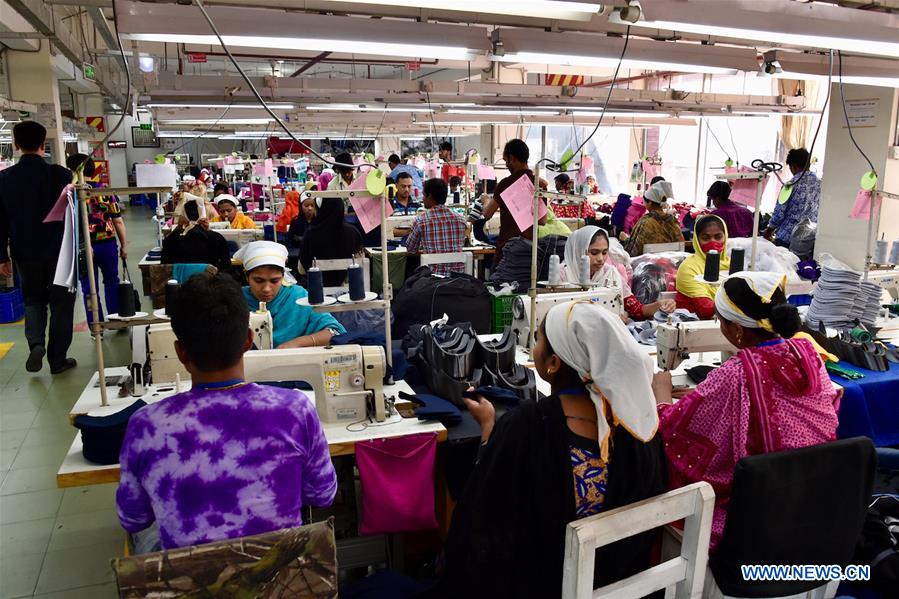
Workers are busy on the production lines at the Bangladesh plant of Mainland Headwear Holding Limited, on the outskirts of the Bangladesh capital Dhaka, Feb. 14, 2019. (Xinhua/Stringer)
by Naim ul karim, Liu Chuntao, Yi Ling
DHAKA, March 24 (Xinhua) -- On the outskirts of the Bangladesh capital, over 5,000 workers are busy on the production lines in a factory, while their children are reading aloud at a school nearby.
The scenes are no strange to Pauline Ngan, founder of the factory, Unimas Sportswear Limited, a Bangladesh plant of Mainland Headwear Holding Limited, one of the world's largest headwear producer.
The company started up in Shenzhen, south China's Guangdong Province, a pilot city for China's reform and opening-up policy. In 2000, it was listed in Hong Kong, where Ngan was born. She established the factory in 2013 in light of the China-proposed Belt and Road Initiative (BRI).
The BRI, proposed by China in 2013, aims to build trade and infrastructure networks connecting Asia with Europe and Africa on and beyond the ancient Silk Road routes. The initiative comprises the Silk Road Economic Belt and the 21st Century Maritime Silk Road.
Located in a little-known village named Bagbari, about a half hour's drive away from Dhaka, the factory currently produces about 120,000 hats everyday for high street brands including NBA, shipping them to the markets around the world and immensely benefiting the Bangladesh people.
"SUPER VILLAGE" RISING FROM JUNGLE
"I could never forget the day when we arrived at Bagbari by oxcart," said Ngan, who is also vice chairperson of the listed company.
"We're (now) planning to put up street lamps to light up the road for our workers to go home in the evening," she said, looking out of her office window, where lorries of products are sent out on the road outside the factory, which has recently been built by the company.
As a bold entrepreneur eager to expand business territory beyond China, Ngan went out to do preliminary investigations for a new plant along the Belt and Road route, and finally set eyes on Bagbari for its good location as well as its abundant and preferential human resources.
"We started with some 200 workers. It's been a long journey to come this far," she said, looking out at the village, previously home to 300 people, mostly farmers who often sought odd jobs at Dhaka.
Nowadays, there are some 10,000 people living here, most of whom are workers of the hat factory. With more and more people flowing into the village, Mohammad Abdul Jalil, a villager who witnessed the great changes over the years, sees new business opportunities.
"I built a house on my own land and rented it out to the factory people. There is now also a private school, which we could never believe could be available before," he said.
"People of this area were extremely poor and there were very poor road communications. This was almost jungle area," said Mohammad Shariful Islam, who is also in the rental business. "The entire area developed a lot following the establishment of the factory. We are all happy."
The development of the factory has also transformed Bagbari into a commercially-vibrant super village, as a new commercial street emerges just outside the factory with sewing training centers run by locals for new comers seeking jobs in Bagbari.
"Who can imagine just six years ago, there was only one small store at the factory gate?" said Li Fuming, senior manager of the factory.
Mohammad Saidur Rahman Liton, a local vendor who used to work as a day laborer, started a fruit store here two years ago. "I have a good sales every evening when the factory workers get off work. My brother is also working in this factory," he said with a big smile.
EMPLOYMENT CHANGES LIFE
After more than six years of development, Ngan is proud to see that the Unimas Sportswear Limited has grown into a modern factory with more than 5,000 workers.
In the factory, the average monthly salary of the workers is about 11,000 taka (131 U.S. dollars), and that of the local managers is about 40,000 taka (477 dollars), much higher than the government's minimum wage of 8,000 taka (95 dollars), said Li, who is planning to expand the local managing team.
A driver in the factory, identified as Sumon, lives with his wife and two children in a rented two-room apartment in a community close to the factory. The rent takes less than a quarter of his monthly income, some 300 U.S. dollars.
"I have bought a refrigerator and a gas stove ... Life is getting so much better than before and we're satisfied," he said.
Hundreds of job seekers flock to the factory office every day, said Ariful Islam, assistant manager of the factory's human resources division. "One or two years after joining this factory, they become financially solvent and they lead a better life."
"I was a senior officer in another factory before joining here. My salary as well as my work environment is far better than the company where I worked earlier. I am totally satisfied," he added.
Among the applicants, a girl known as Konika received her secondary school certificate in 2017 and hopes to become an apprentice. "I have come to know that this factory is going to recruit people in various positions. If given an opportunity, I would put in my best efforts," she told Xinhua.
Women make up 60 percent of the factory workforce. Lectures on women's rights are held regularly to ensure that female workers know how to protect their rights, said Li.
STORIES TO CONTINUE
For Ngan and Unimas, it is just the beginning of a new journey. The factory is still growing, with 100 million yuan (14.9 million dollars) being invested into the construction of a new 12-story building, which will host 10,000 workers in the future.
Undoubtedly, Unimas Sportswear Limited has incited a big boom for local employment and economic development. As the practical cooperation deepens between China and Bangladesh, more and more similar stories will be told.
As Bangladesh's largest trading partner, China has also been building the 25-meter-wide and 10-km-long Padma Bridge, the largest of its kind in Bangladesh.
In June 2014, the Bangladeshi government awarded China Major Bridge Engineering Company Limited a 1.55-billion-dollar contract to build the core structure of the Padma Bridge project.
Being built above the Padma River, one of the three major rivers in Bangladesh, the bridge will shorten the travel time between the capital city and the districts in the country's southernmost region from 13 hours to about three, benefiting nearly 30 million people.
By enhancing regional trade and collaboration along the Asian highway No. 1 and the Trans-Asian railway network, the bridge is expected to promote Bangladesh's trade and overall economy, which, according to a World Bank report, has the potential to end extreme poverty by 2030.
As China's third largest trading partner in South Asia, Bangladesh has in the past five years received 8,107 million dollars of Chinese investment, the highest in the 45 countries and regions, Bangladeshi Foreign Minister AK Abdul Momen said in a recent interview.
Both China and Bangladesh are developing countries with a huge population, and the goals of the two countries are well aligned, said Bangladeshi Commerce Minister Tipu Munshi.
He added that in the next 10-15 years, China is expected to invest more than 50 billion dollars in Bangladesh's thrust sectors such as energy and power, transport and communications, among others.
"China has been a trusted partner of Bangladesh for a long time now. Bangladesh has boarded the highway of development, and China has been a key partner in this journey," he said.
(Video editor: Liu Ruoshi)
