 ?
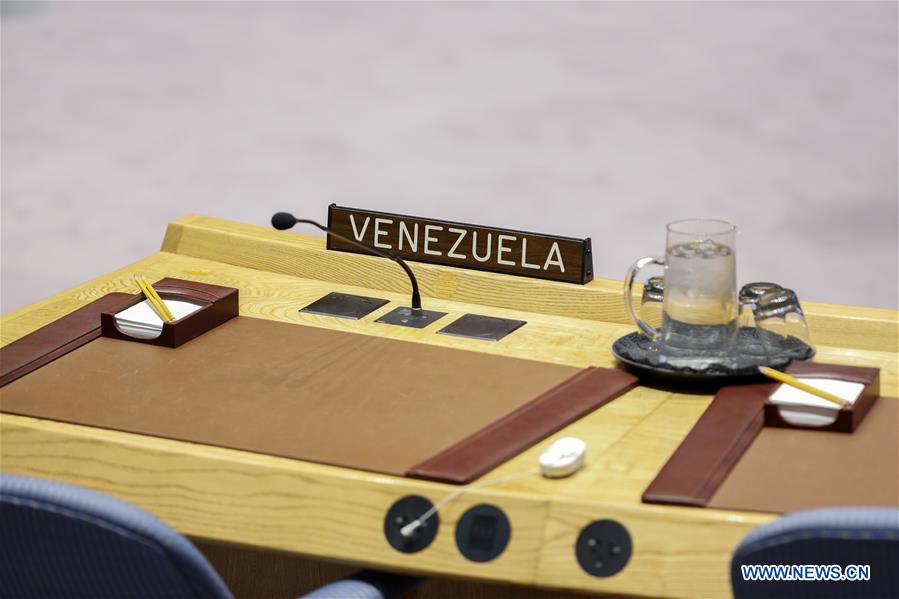
?The nameplate of Venezuela is pictured prior to a United Nations Security Council meeting on the situation in Venezuela, at the UN headquarters in New York, on April 10, 2019. United Nations Under-Secretary-General for Humanitarian Affairs and Emergency Relief Coordinator Mark Lowcock on Wednesday asked for more money to support the expansion of humanitarian programs in Venezuela. (Xinhua/Li Muzi)
UNITED NATIONS, April 10 (Xinhua) -- UN Undersecretary-General for Humanitarian Affairs Mark Lowcock on Wednesday asked for more money to support the expansion of humanitarian programs in Venezuela.
"The resources available now are extremely modest in relation to the needs we see. I would like to thank member states which have contributed to the provision of humanitarian assistance in Venezuela... Your continued support is critical. But we need a lot more," Lowcock told the Security Council.
He also asked for an enabling operating environment for humanitarian assistance, including sustained and regular access to people in need.
He commended the Venezuelan government for its steps to facilitate the entrance of additional UN staff into the country and the expansion of humanitarian programs. But at the same time, he noted that additional steps are needed.
"We need more humanitarian organizations with the capacity to meet urgent needs to establish a presence and assist with operations in the country. We also need more data and information to ensure our understanding of needs evolves with the situation."
Lowcock asked for improved respect for principled humanitarian action.
In Venezuela, there is a need to separate political and humanitarian objectives. Humanitarian assistance must be delivered on the basis of need alone, he said.
The humanitarian situation in Venezuela has worsened since UN Undersecretary-General Rosemary DiCarlo last briefed the Security Council on Feb. 26, said Lowcock.
"Let me be clear from the outset that there is a very real humanitarian problem in Venezuela," he told the Security Council.
Recurrent widespread power outages have affected the whole country. Without electricity from the grid, many hospitals have struggled to carry out essential surgical procedures, and to sustain intensive-care services and dialysis treatment, said Lowcock.
Water and sewage systems have been interrupted. Economic decline has continued and the purchasing power of ordinary people has fallen further, rendering food even less affordable for many families, he said.
The United Nations estimates that 7 million people in Venezuela, or about a quarter of the overall population, need humanitarian assistance.
He explained that the context is a severe and continuing economic contraction, with associated dramatic increases in inflation, on a scale seen in few if any other countries around the world in recent years.
A UN review has found that access to nutrient-rich foods and a varied diet has diminished. Historically, Venezuela has imported up to 75 percent of its food. As a result of the crisis, the availability and affordability of food have fallen, with lower imports, reduced local production and declining purchasing power, he said.
The United Nations estimates that 1.9 million people require nutritional assistance, including 1.3 million children under 5, said Lowcock.
The Venezuelan health system is strained by shortages in personnel, medical supplies, equipment and electricity. Reduced access to medicines has increased the risk of morbidity and mortality from diabetes, hypertension, cancer and HIV/AIDS. Preventable diseases like tuberculosis, diphtheria, measles and malaria have resurfaced.
The World Health Organization registered more than 400,000 cases of malaria in 2017, nearly 70 percent more than the year before. That was the largest increase in the world that year, said Lowcock.
Some 2.8 million people need health assistance, including 1.1 million children under 5, he said.
The world body and other humanitarian organizations are on the ground, and have been expanding their operations, he said. Since 2017, the number of UN staff has increased from 210 to nearly 400. UN agencies are working in all 24 states of Venezuela.
Lowcock asked for more support as the scale of need is significant and growing. "The United Nations is willing and able to respond, consistent with the long-standing mandate member states have agreed for principled humanitarian action. We can do more to relieve the suffering of the people of Venezuela, if we get more help and support from all stakeholders."