BEIJING, July 4 (Xinhua) -- Chen Luojing, a designer with the China Academy of Space Technology, was surprised at the public's enthusiasm for the country's space programs.
In a display during the 19th China National Science and Technology Week in May, an event to popularize science, throngs of visitors came to watch the model of lunar rover Yutu-2, which was developed by Chen's academy.
"They were very interested in how Yutu-2 works on the far side of the moon. One visitor even asked me how the Queqiao relay satellite sets the communication link between Earth and the probe," Chen recalled.
China has made great progress in science and technology in recent years, from probing space to exploring the deep sea, and from observing the universe to researching micro particles. Advances have fueled the public zeal for science.
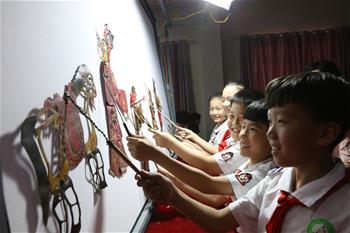
Over 310 million visits were paid to more than 21,000 science popularization events during the week. "It is inspiring to learn about new technologies so closely," said a visiting middle school student.
Yutu-2 has driven more than 200 meters on the far side of the moon to conduct research.
The rover was reported to have found materials from deep inside the moon that could help unravel the mystery of the lunar mantle composition. The research has been published online by the academic journal Nature.
China launched the Chang'e-4 probe on Dec. 8, 2018. Its lander and Yutu-2 made the first-ever soft-landing on the far side of the moon on Jan. 3.
Since the launch of its first satellite in 1970, China has achieved one feat after another in space.
In 2003, China's first astronaut Yang Liwei went into space on the Shenzhou-5 craft. So far, the country has launched two space labs into orbit. Tiangong-2, the second, accommodated two astronauts for 30 days and hosted a series of cutting-edge science experiments, such as quantum key distribution, a cold atomic clock and gamma ray burst observation.
Now China is building its own space station, which is expected to be operational around 2022. To lay the groundwork for its construction, China will carry out joint tests and exercises by the end of this year to prepare for the maiden flight of the Long March-5B, according to the China Aerospace Science and Technology Corporation.
China also has a busy schedule for other space activities. It will send more than 50 craft into space via over 30 launches this year, including the launch of the Long March-5 carrier rocket and the Chang'e-5 lunar probe.
China is pursuing a development path driven by innovation, which is at the heart of the country's 13th Five-Year Plan (2016-2020). Basic research, as a fundamental source of innovation, has received more priority as well as longer and more stable support.
Major breakthroughs in basic research are highlighted at annual awards honoring distinguished scientists, engineers and research. This year, Xue Qikun, 55, won the State Natural Science Award for pioneering contributions to the quantum anomalous Hall effect.
His research will help accelerate the development of low-power consumption electronics and is an important boost to human scientific knowledge, said Professor Xue Qikun, of Tsinghua University and a Chinese Academy of Sciences academician.
Over the past 40 years, China has granted more than 100,000 national science awards, covering achievements in areas such as high-temperature superconducting materials, supercomputers and hybrid rice.
Moreover, major facilities like the 500-meter Aperture Spherical Radio Telescope nicknamed "Tianyan" in southwest China's Guizhou Province, the neutrino facility of Dayawan Nuclear Power Plant in south China's Guangdong Province, and the experimental superconducting tokamak magnetic fusion energy reactor in east China's Anhui Province are also world-renowned.
In 2018, research and development spending in China rose 11.6 percent to more than 1.96 trillion yuan (285.3 billion U.S. dollars), accounting for 2.18 percent of GDP. Patent applications numbered 4.32 million, up 16.9 percent.
China has the world's largest number of R&D personnel, and ranks second for the number of scientific papers published in international journals.
China ranked third worldwide in citations of science and technology papers by its researchers. Chinese scientists contributed 16,900 of the world's most-cited papers in the decade to 2016, or 12.8 percent of the global total, according to the Institute of Scientific and Technical Information under the Ministry of Science and Technology.
"China's basic research is under a critical transition from quantity accumulation to a quality leap, and from some breakthroughs to overall capability enhancement," Xue said.