




HANGZHOU, July 7 (Xinhua) -- The Archaeological Ruins of Liangzhu City, located in east China's Zhejiang Province, have gained the world's recognition as a testimony to the existence of at least 5,000-year-long Chinese civilization.
On Saturday, the United Nations Educational, Scientific and Cultural Organization (UNESCO) World Heritage Committee inscribed the ruins on the World Heritage List as a cultural site at a session held in Baku, Azerbaijan.
The inclusion has brought the total number of World Heritage sites in China to 55, the highest in the world.
"The Archaeological Ruins of Liangzhu City are both a major archaeological discovery of China in the 20th century and a key cultural site that bears testimony to the over 5,000-year-long Chinese civilization," said Liu Yuzhu, head of China's National Cultural Heritage Administration.

Members of the Chinese delegation celebrate the inscription of China's Archaeological Ruins of Liangzhu City on the World Heritage List during the 43rd session of the UNESCO World Heritage Committee in Baku, Azerbaijan, July 6, 2019. (Xinhua/Tofik Babayev)
ANCIENT CIVILIZATION
The Liangzhu ruins were once the center of power and belief of an early regional state in the lower reaches of the Yangtze River in Late Neolithic China.
Located in the eastern foothills of the Tianmu Mountains in a plain crisscrossed by a network of rivers, the property consists of four component parts: the Area of Yaoshan Site; the Area of High-dam at the Mouth of the Valley; the Area of Low-dam on the Plain - Causeway in Front of the Mountains; and the Area of City Site.
"The property testifies to the existence of a regional state with a unified belief system and supported economically by rice-cultivating agriculture in late Neolithic China," said a report issued by the International Council on Monuments and Sites. "It also represents an early urban civilization with complex functions and structures."
In 1936, Shi Xingeng, a 24-year-old researcher with the West Lake Museum carried out extensive surveys and excavations in Liangzhu on the outskirts of Hangzhou, capital of Zhejiang. He and local farmers later discovered pieces of light black pottery and stone artifacts, bringing for the first time the ancient civilization to light.
Over the following decades, the Liangzhu ruins have been excavated, researched and conserved through various archaeological efforts. Understanding of the sites has grown from being merely a complex of tombs to a comprehensive large-scale heritage site.
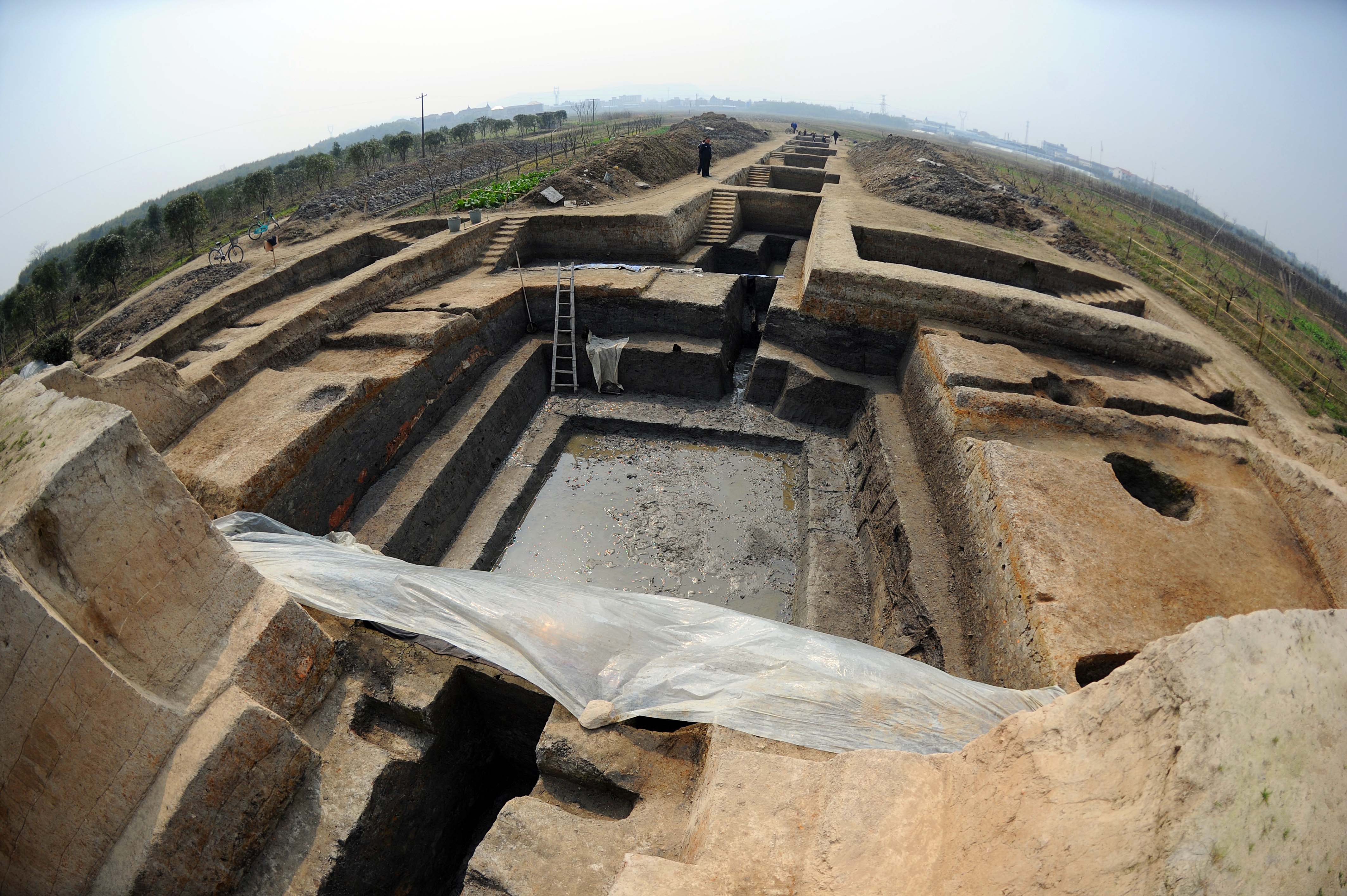
Photo taken on March 9, 2011 shows a view of Liangzhu relic site in Hangzhou, east China's Zhejiang Province. (Xinhua/Xu Yu)
In 2007, Chinese archeologists discovered in Liangzhu an ancient city dating back about 5,000 years.
"Liangzhu's ancient city is one of its kind in China," Zhang Zhongpei, a famed archaeologist and former curator of the Forbidden City Museum, said after the discovery. "It can be rightfully called the first and the foremost city of China."
In 2015, the discovery of a water project in Liangzhu that includes 11 dikes was announced. It is the oldest large water system ever found in China and is believed to have combined functions of flood control, transportation and irrigation.
Its contemporary counterparts overseas were built mainly in arid areas like ancient Egypt and Mesopotamia, making this discovery in the humid area near the Yangtze River unusual.
Carbon-dating tests on construction material taken from the dikes -- straw and bamboo -- showed dates of the site as between 4,700 and 5,100 years old.

People visit Liangzhu Museum in Hangzhou, capital of east China's Zhejiang Province, June 26, 2018. (Xinhua/Weng Xinyang)
5,000-YEAR-OLD TESTIMONY
Colin Renfrew, professor of Archaeology at the University of Cambridge, believed that the discovery of the Liangzhu ruins has taken the inception of the Chinese civilization about 1,000 years earlier.
"It's fully 1,000 years before what has usually been recognized as the first flourishing of the Chinese civilization, with the Shang dynasty, or the proceeding Xia Dynasty," said Renfrew, an internationally renowned archaeologist. "That's why it's certainly well worth being on the World Heritage List of UNESCO."
Liu Yuzhu said Liangzhu's inscription is of immense significance to Chinese civilization.
"Its inclusion on the World Heritage List proved that this fact has been widely recognized by the international community," said Liu.
He said Chinese authorities will redouble their efforts on upgrading the protection level of the site and coping with a potential boom of tourism, in a bid to better preserve the ruins.
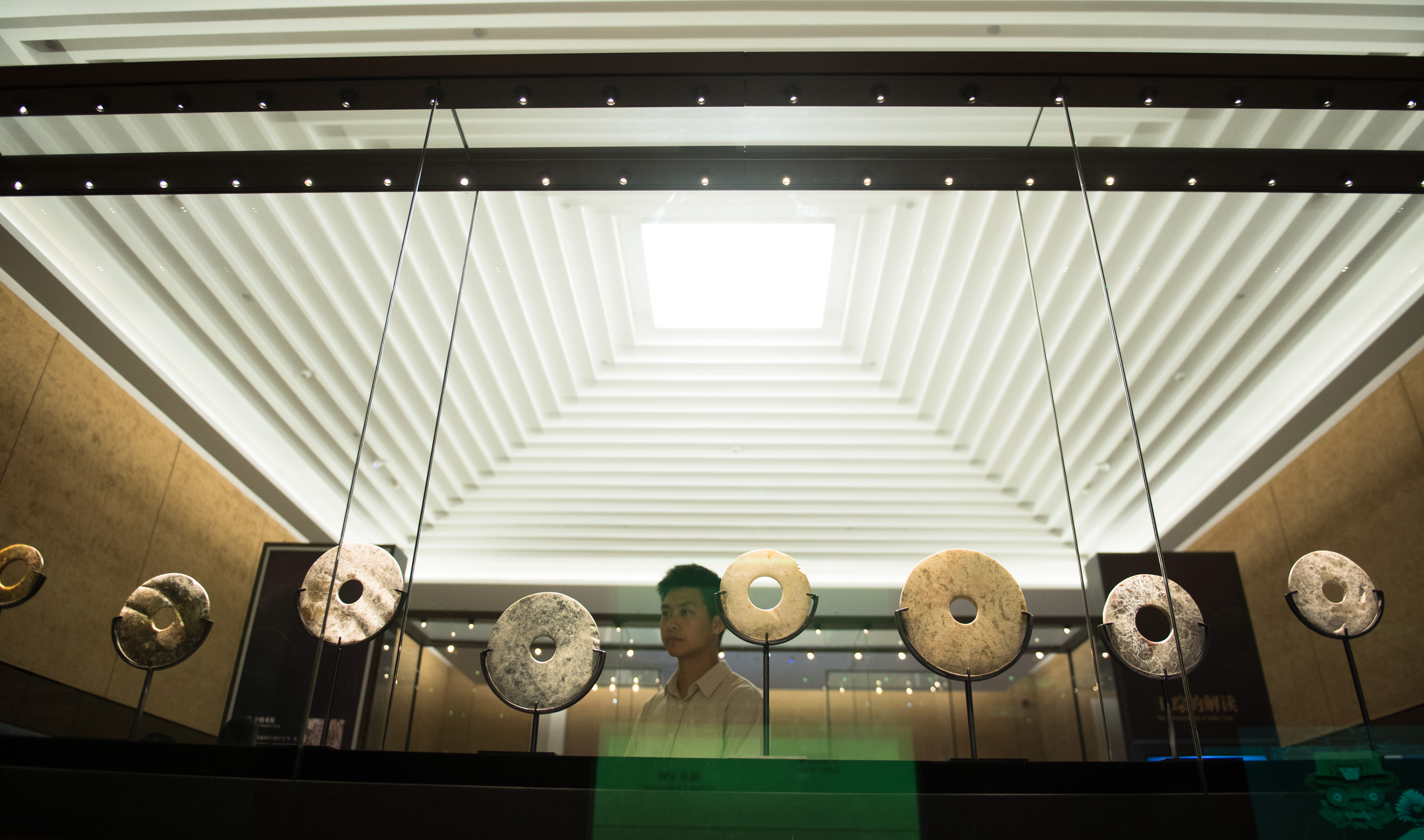
A man looks at jade artifacts excavated from Liangzhu relic site in Hangzhou, capital of east China's Zhejiang Province, June 22, 2019. (Xinhua/Weng Xinyang)
Liu Bin, the head of the Zhejiang provincial institute of archaeology, said there is still a long way to go before archaeologists can fully understand the ancient Liangzhu civilization.
Citing the examples of the ancient city of Pompeii, Giza Pyramids and Emperor Qinshihuang's Mausoleum, Liu said excavation efforts of world famous heritage sites often took over a hundred years.
"Despite the fact that the historical value of Liangzhu has been widely recognized, we have only unveiled a part of the mysteries of the Liangzhu civilization. Many archaeological puzzles remain unsolved," he said.
(Video reporters: Kong Linghang, Wang Yiwen, Li Tao, Yin Xiaosheng, Feng Yuan, Jin Jing, Zhang Dailei, Li Yafei, Zhang Ruoxuan, Liao Bingqing. Editor: Zheng Xin)
