





People celebrated the 1000-day countdown to the Beijing 2022 Olympic Winter Games in Chongli of Zhangjiakou City, north China's Hebei Province, on May 11, 2019. (Xinhua/Xing Guangli)
By sportswriter Bai Lin
SHIJIAZHUANG, July 31 (Xinhua) -- Five years ago, Yu Lei was a security guard at a residential community in Beijing. If he had not been doing that, he would have been growing corn on his farm in Chongli, a small town in northern China.
Today he is a skiing instructor and his home town has become the focus of international attention as it prepares to host the 2022 Winter Olympic Games along with Beijing.
July 31 marks the fourth anniversary since Beijing won the bid to host the Games. The Games, set to be held in less than three years, have been making a huge impact on local people's lives in the places where venues and infrastructure are being built.
Yu has seen his own life and that of his town in Hebei province transformed. His income has increased from 2,000 yuan (290 US dollars) a month to nearly 10,000 (1,452 US dollars) yuan a month as an instructor at a ski resort.
Chongli, situated 200 kilometers northwest of Beijing, had just one skiing resort in 2003. Today, it has seven.
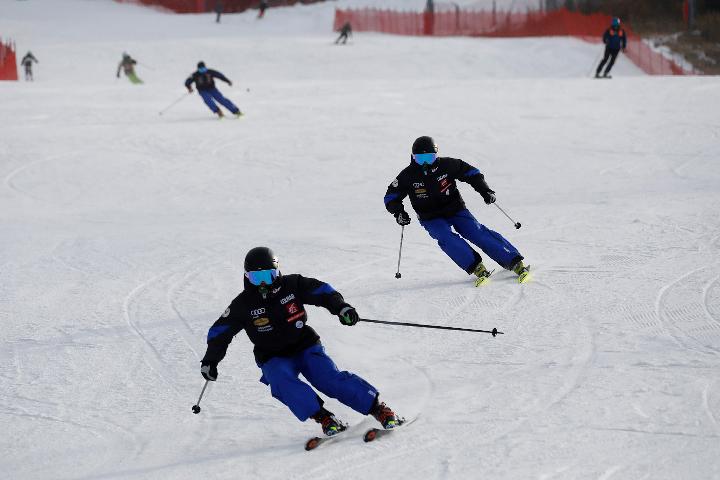
People ski at a resort in Chongli County of Zhangjiakou, north China's Hebei Province, Nov. 17, 2018. (Xinhua/Wu Diansen)
According to local official statistics, 30,000 out of 126,000 local residents are now doing jobs related, directly or indirectly, to the Winter Olympics.
"Developing the skiing industry and hosting the Games have changed our lives a lot," Yu said. "We used to get very few visitors. Now we are getting tens of thousands a year."
Yang Jingzhi, former Hebei Sports Bureau vice-director, has witnessed the tremendous changes that have taken place. He remembers his first visit to Chongli, nestled among mountains near part of the Great Wall about 10 years ago. "White clouds, black land, green trees and grass, and the fresh air made a big impression on me."
But he also noticed the poverty. "The residents were so poor that their houses were made of soil or stone, even half underground," he said.
"At that time, people there earned a little money by selling wild mushrooms, while gold resources were the main income of Chongli," Yang added.
For young people, the employment options were limited: they could be a farmer or a miner of low-quality gold.
Yu decided to go back to his hometown to be a skiing instructor in the end of 2015, when ski resorts started to recruit instructors to meet the increasing demand.
Now he teaches children to ski. "Some children can ski independently after two to four hours, which brings me a sense of achievement. Skiing may be the career of my lifetime," he said.
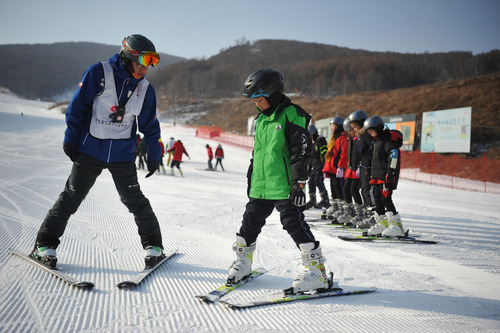
Students practise skiing at a ski ranch in Chongli of Zhangjiakou City, north China's Hebei Province, Dec. 10, 2018. (Xinhua/Geng Jun)
Since Beijing was awarded the Games in July 2015, more and more young people in Chongli have been trained and hired by ski resorts as instructors, while others have also found jobs as security guards or service staff, or run restaurants around the resorts.
In addition to Yu, his parents also have found jobs at a ski resort.
The once poverty-stricken area has now been lifted out of poverty, local authorities said this May.
The number of ski resorts rose to seven last year from four in 2015 and the number of ski courses has doubled. Wanlong, Thaiwoo, Genting Resort Secret Garden and Fulong were listed as the top 10 ski resorts across the country last year.
The town's income has more than doubled from 440 million yuan (about 63.9 million US dollars) in 2015 to 1.015 billion yuan (about 147 million US dollars) last year.
It has seen an increase of nearly 200 million yuan per year since Beijing won the bid to host the 2022 Winter Olympics. Last year was the first time that Chongli's total fiscal revenue exceeded 1 billion yuan (about 145 million US dollars).
But not everyone is happy about this. Some residents complain that their tranquil hometown had been disrupted by increasing numbers of tourists.
The mine owners are unhappy. They have been forced to close the mines by the government, which pledged to remove them in order to cut pollution.
Some miners have found other jobs. In Shizuizi town of Chongli district, one miner has taken to growing roses.
"It is very painful to close down, but it's beneficial to the locals in the long term," he said.
The service industry has replaced the mining industry, which was the economic mainstay here for decades. The tax revenue from the service industry accounted for 71.4 percent of the city's total tax revenue in 2018.
Although the global spotlight will focus on Chongli in less than three years, what will be left to the local residents when the Olympics are over? It has been suggested that Chongli needs to continue to modernize its industries in order to ensure lasting, sustainable development.
Zhao Zan, district government chief of Chongli district, said the Winter Games had boosted the structural transformation of Chongli's economy.
"We will continue to introduce various projects related to sports, tourism, health and culture this year," he said.
Chongli has begun to garner serious international attention as a top travel destination. In January 2019, it was selected by The New York Times as one of the "52 places to travel to in 2019" for its booming ski industry.
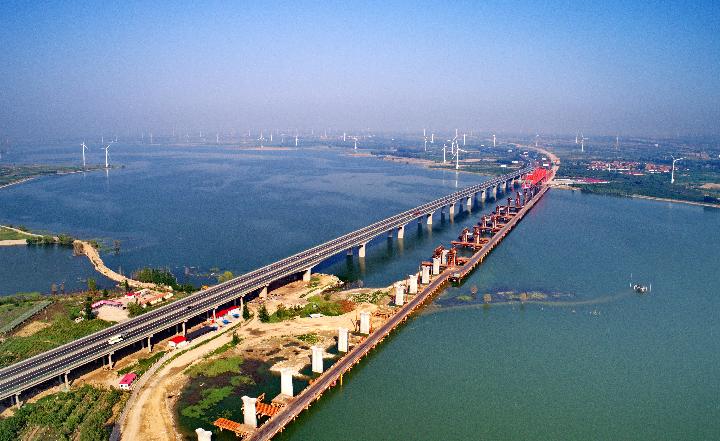
The construction site of Guanting Reservoir grand bridge, a section of the Beijing-Zhangjiakou high-speed railway line. The new railway will boast a speed of 350 kilometers per hour, and will take less than one hour to travel from Beijing to Zhangjiakou. (Xinhua/Yang Shiyao)
A high-speed railway between Beijing and Chongli is under construction and set to be open this year. The one-hour journey will open Chongli even more to the outside world.
Meanwhile, Yu is working hard and is eager to study skiing in Northern Europe, with the aim to be a top-level skiing instructor in the future. "It would be a dream come true for me if I could play a part in the Winter Olympics in my hometown," he said.
