
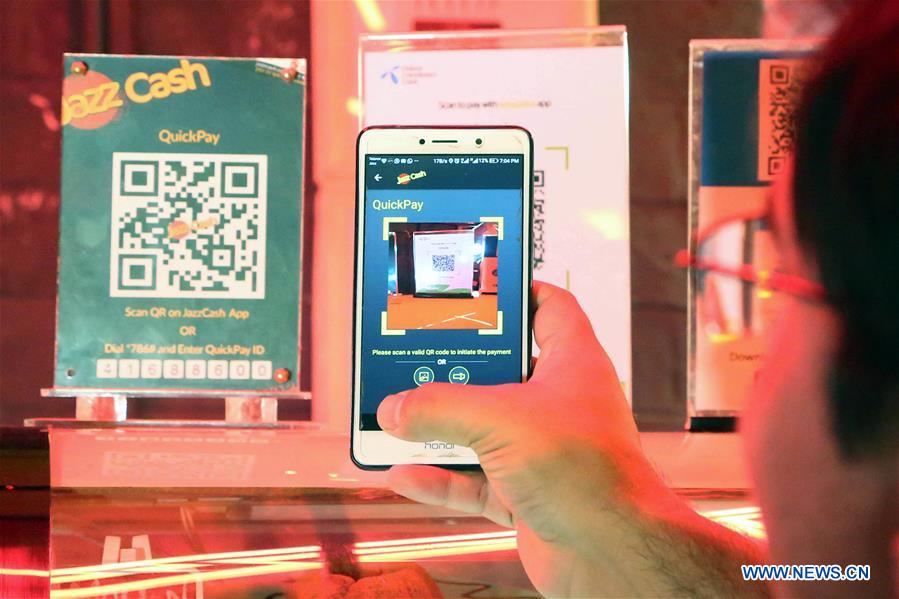
Photo taken on Aug. 21, 2019 shows a Pakistani man scanning a QR code to pay his restaurant bill in Islamabad, capital of Pakistan. With increasing digitization and internet accessibility, e-commerce market of Pakistan is becoming one of the fastest growing markets across the globe, with a considerable surge in online merchants, e-commercial platforms and online payment facilities in recent times. (Photo by Ahmad Kamal/Xinhua)
by Raheela Nazir
ISLAMABAD, Aug. 29 (Xinhua) -- With increasing digitization and internet accessibility, e-commerce market of Pakistan is becoming one of the fastest growing markets across the globe, with a considerable surge in online merchants, e-commercial platforms and online payment facilities in recent times.
According to the latest data released by the State Bank of Pakistan, the size of the e-commerce market of Pakistan has increased by 92 percent to 99.3 billion rupees (about 640.3 million U.S. dollars) during the fiscal year 2017-18 as compared to the previous year. The size of the market was 51.8 billion rupees (about 332 million dollars) in the previous fiscal year.
The number of registered e-commerce merchants was 496 in the first quarter of the fiscal year 2017-18, which reached nearly 1,100 by yearend and were over 1,200 in the first quarter of 2018-19, showing an exponential growth in e-commerce activities in the country, according to the official figures.
Pakistan has e-commercial companies in almost every major sector from retail and ride-hailing to property and car purchasing. Various benefits such as lower transaction cost, ease of selection of various products while sitting at home, wider selection range, opportunity for making informed purchase decisions based on online reviews and on-time delivery process are the main sources of attraction for the consumers, paving way for the flourishing of the industry.
Leading online businesses in Pakistan in retail are Daraz, Yayvo, HumMart among others, whereas ride-hailing services have been overtaken mostly by the global and regional giants Uber and Careem. Additionally, PakWheels and Zameen are the largest online marketplace for car and property shoppers and sellers in Pakistan. Among food delivery service providers, FoodPanda is being widely used by the citizens.
The industry has not only helped major players in expanding their businesses, it was also an effective tool for small and medium scale enterprises due to low cost and increased accessibility of sellers to customers.
In its efforts to increase the growth and development of the industry, the federal government has recently framed a draft e-commerce policy aimed at achieving higher export growth through enhanced activities from e-commerce platforms, promoting small e-businesses and creating employment opportunities.
The main goal of the policy is to augment e-commerce industry's growth to make it one of the key drivers of Pakistan's economy.
Though a statistical data shows a steady rise in digital transactions and the number of registered vendors, the country's successful e-commerce entrepreneurs believe that Pakistan can learn much from China to further boost the industry, which is still in its infancy as the latter has the immense knowledge base, experience and advanced technology in this field.
In a conversation with Xinhua, Adam Dawood, head of Yayvo, one of Pakistan's largest online retailer, said China is the world's biggest e-commerce market with annual online sales worth hundreds of billions of dollars.
Being a neighboring country, China fathomed the huge untapped potential of Pakistani e-commerce industry, with Chinese e-commerce giant "AliExpress" recently acquiring one of the leading e-commerce company named Daraz in Pakistan.
"Apart from investment in Pakistan, China has such a big market for products that we could increase our product assortment overnight," Dawood said, adding that there is a lot of learning required in terms of product-market fit, legislation, and route to market that would help Pakistan increase not just online shopping base, but to further increase internet penetration rate.
Talking about the challenges the e-commerce industry is currently facing, Dawood said that Pakistan now needs to focus on optimizing the overall service delivery and customer experience aspects.
"Our logistics and payments systems need to evolve to be better suited, it behooves the government to pass legislations and cooperate and collaborate with regional players including China to further support and actively promote the digital businesses."
Pakistan needs to encourage Chinese enterprises to explore opportunities in the Pakistani e-commerce industry and join hands with local start-ups for new business ventures, Shehryar Hydri, secretary general of Pakistan Software Houses Association, a trade body promoting and developing software and services industry in Pakistan, told Xinhua.
"We need to partner with Chinese producers and help them open hubs in Pakistan for onward export to regional markets," said Hydri, adding that something that has been ignored so far is the opportunity to sell back to China and discover new niches through these online platforms.
"As Chinese company AliExpress already on boards more local vendors to sell products locally as well as to other countries, Pakistani e-commerce ecosystem will get mature and sellers will be able to tap new markets," Hydri said.
Talking to Xinhua, Brakaan Saeed, chief executive officer at Vizteck Solutions, a leading Islamabad-based software company, said most of the country's e-commerce industry is still based on cash-on-delivery system and that is about 90 percent. People are reluctant to pay through online payment methods as there is a huge trust deficit between buyers and sellers which is hindering the growth of e-commerce in Pakistan.
"China can help bridge this gap by establishing payment model called 'escrow' in Pakistan as adopted by various e-commerce companies in China."
Earlier this year, in an effort to further develop mobile payment modes and digital financial services in the country, Telenor Microfinance Bank, Valyou, and Telenor's Easypaisa in collaboration with Chinese company Alipay, the world's largest mobile payment platform, have jointly launched a block chain-based international remittance service in Pakistan.